Thursday, May 27, 2010

SLIPPERY SLOPE THEOLOGY


People and organizations looking for new members,or networking opportunities often send me emails because the words "anglican," "catholic" and "priest" appear in my email address. Today I received a notice from a Lutheran church located not far away from St. Hilda's. I suppose that the text was written for insiders because of its frank admission that the members of the parish, or at least the ones with the power, admit that they are acting as a "change agent." Here follows their notice:
[Sunday, June 13, the community of St. John's Lutheran Church , 1410 Ponce de Leon Ave. , will gather at 10:30 a.m. to affirm it's calling to be a congregation of love, welcome, and service with a special Affirmation of Christian Ministry liturgy. Recognizing its role as a change agent in the ELCA, St. John’s looks forward to claiming a role as a more diverse community, to be an agent of reconciliation for people who are struggling with the changes, and to be positive participant in the Southeastern Synod. The Rev. Jane Fahey, pastor at Druid Hills Presbyterian Church, will preach. Pastor Brad Schmeling starts a new Bible study series June 2, Wednesday nights at 7.]
The first question that comes to my mind upon reading this is, if the ELCA has been wrong for all these centuries in such a profound way about the scriptural teachings regarding the correct use of our sexuality, then what else might she be in error on?

It is better to not belong to such an uncertain church. In such an environment all belief is up for change. When the ultimate theological question is asked, "What think ye of Christ, whose son is he?" You will be amazed at the answers you will get from this crowd.

Tuesday, May 11, 2010

Leonidas Polk Memorial Services June 19, 2010 10:00 a.m. at Pine Mountain 6:00 p.m. at St. Hilda’s Church

The Polk SCV Camp of Smyrna and St. Hilda’s Church will conduct two memorials for Bishop-General Leonidas Polk on Saturday, June 19, 2010. The first service will be held at Pine Mountain at 10:00 a.m. The second service will be at St. Hilda’s Church at 6:00 p.m. Go to www.sthildasacc.org for directions to Pine Mountain and the Church.
The services commemorate the bishop’s life-long dedication to Christ and the church, as well as his sacrifice for our country. As a Confederate corps commander, General Polk fell in battle at Pine Mountain, Georgia on June 14, 1864.
All are encouraged to join the Polk Camp and St. Hilda’s Church in honoring this brave Christian soldier. Immediately after the 6:00 p.m. service, St. Hilda’s will host a reception. Donations welcome! Period dress encouraged.

Monday, May 10, 2010

Slippery Slope in Vienna

A recent news article reports that an Austrian cardinal has advised that the "quality of homosexual relationships should be examined." He also comments that people hardly marry anymore, so what's the big deal about same sex coupling and divorce? You can read it all here http://www.lifesitenews.com/ldn/2010/may/10051004.html . Someone should tell the Cardinal that most folks, especially in Europe, don't bother to go to church anymore either. With Roman Cardinals like this why bother.

Saturday, March 13, 2010

Caught in the Middle


In the latest issue of “The Latin Mass” magazine Editor in Chief John W. Blewit made the following remarks; “…the USCCB has returned to its usual bureaucratic form in taking on a political issue that is best left to the deliberations of elected politicians. The U.S. Bishops have announced a campaign to mobilize (Roman) Catholics for comprehensive immigration reform led by Bishops of Salt Lake City, Utah and Albany, New York. Their committee includes two nuns-one a sister of Notre Dame from Cleveland, Ohio, and the other a Sister of Saint Joseph from Philadelphia, Pennsylvania- and a staff member of the USCCB. This self-serving and politically correct committee is bound to increase the number of meetings for the bureaucrats in the Church, if that’s possible.”

And; “Pope Benedict XVI has taken the initiative to entice Anglican traditionalists (an oxymoron to say the least) to convert to Roman Catholicism. This gesture on the part of Pope Benedict prompted Austen Lueveigh, a former adviser to the Roman Catholic Archbishop of Westminster, to comment that the Pope’s announcement is ‘historic because it allowed for the gradual absorption into the Roman Catholic Church huge numbers of Anglicans who are conservative in their Theology and Liturgy.’ What Pope Benedict has done with his new provisions allows groups of Anglicans from around the world to join new parishes headed by former Anglican prelates who will provide spiritual guidance to Anglicans who wish to be Roman Catholics. Called “personal ordinariates” they will be established within local Roman Catholic dioceses.”

I respect traditional Roman Catholics (not an oxymoron in my book) and wish them God's blessing. I also appreciate “Latin Mass” magazine pointing out that those who join Rome will be “former Anglicans.”

Tuesday, December 29, 2009

Affirmation of St. Louis

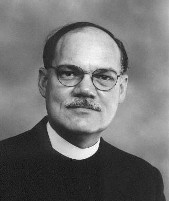
The late Bishop Albert Chambers, shown at left, consecrated bishops for the Continuing Anglicans who adopted the Affirmation of St. Louis in 1977. We are asking Anglicans to recommit themselves to the Affirmation by leaving their names at the url underneath the Bishop's photo.
http://affirmationofstlouis.blogspot.com/

Wednesday, December 02, 2009

"Dr. Fundamentalis": H. L. Mencken's Obituary of Machen


The Rev. J. Gresham Machen, D.D., who died out in North Dakota on New Year's Day [editor's note: 1937], got, on the whole, a bad press while he lived, and even his obituaries did much less than justice to him. To newspaper reporters, as to other antinomians, a combat between Christians over a matter of dogma is essentially a comic affair, and in consequence Dr. Machen's heroic struggles to save Calvinism in the Republic were usually depicted in ribald, or, at all events, in somewhat skeptical terms. The generality of readers, I suppose, gathered thereby the notion that he was simply another Fundamentalist on the order of William Jennings Bryan and the simian faithful of Appalachia. But he was actually a man of great learning, and, what is more, of sharp intelligence.

What caused him to quit the Princeton Theological Seminary and found a seminary of his own was his complete inability, as a theologian, to square the disingenuous evasions of Modernism with the fundamentals of Christian doctrine. He saw clearly that the only effects that could follow diluting and polluting Christianity in the Modernist manner would be its complete abandonment and ruin. Either it was true or it was not true. If, as he believed, it was true, then there could be no compromise with persons who sought to whittle away its essential postulates, however respectable their motives.

Thus he fell out with the reformers who have been trying, in late years, to convert the Presbyterian Church into a kind of literary and social club, devoted vaguely to good works. Most of the other Protestant churches have gone the same way, but Dr. Machen's attention, as a Presbyterian, was naturally concentrated upon his own connection. His one and only purpose was to hold it [the Church] resolutely to what he conceived to be the true faith. When that enterprise met with opposition he fought vigorously, and though he lost in the end and was forced out of Princeton it must be manifest that he marched off to Philadelphia with all the honors of war.

II
My interest in Dr. Machen while he lived, though it was large, was not personal, for I never had the honor of meeting him. Moreover, the doctrine that he preached seemed to me, and still seems to me, to be excessively dubious. I stand much more chance of being converted to spiritualism, to Christian Science or even to the New Deal than to Calvinism, which occupies a place, in my cabinet of private horrors, but little removed from that of cannibalism. But Dr. Machen had the same clear right to believe in it that I have to disbelieve in it, and though I could not yield to his reasoning I could at least admire, and did greatly admire, his remarkable clarity and cogency as an apologist, allowing him his primary assumptions.

These assumptions were also made, at least in theory, by his opponents, and thereby he had them by the ear. Claiming to be Christian, as he was, and of the Calvinist persuasion, they endeavored fatuously to get rid of all the inescapable implications of their position. On the one hand they sought to retain membership in the fellowship of the faithful, but on the other hand they presumed to repeal and reenact with amendments the body of doctrine on which that fellowship rested. In particular, they essayed to overhaul the scriptural authority which lay at the bottom of the whole matter, retaining what coincided with their private notions and rejecting whatever upset them.

Upon this contumacy Dr. Machen fell with loud shouts of alarm. He denied absolutely that anyone had a right to revise and sophisticate Holy Writ. Either it was the Word of God or it was not the Word of God, and if it was, then it was equally authoritative in all its details, and had to be accepted or rejected as a whole. Anyone was free to reject it, but no one was free to mutilate it or to read things into it that were not there. Thus the issue with the Modernists was clearly joined, and Dr. Machen argued them quite out of court, and sent them scurrying back to their literary and sociological Kaffeeklatsche. His operations, to be sure, did not prove that Holy Writ was infallible either as history or as theology, but they at least disposed of those who proposed to read it as they might read a newspaper, believing what they chose and rejecting what they chose.

III
In his own position there was never the least shadow of inconsistency. When the Prohibition imbecility fell upon the country, and a multitude of theological quacks, including not a few eminent Presbyterians, sought to read support for it into the New Testament, he attacked them with great vigor, and routed them easily. He not only proved that there was nothing in the teachings of Jesus to support so monstrous a folly; he proved abundantly that the known teachings of Jesus were unalterably against it. And having set forth that proof, he refused, as a convinced and honest Christian, to have anything to do with the dry jehad.

This rebellion against a craze that now seems so incredible and so far away was not the chief cause of his break with his ecclesiastical superiors, but it was probably responsible for a large part of their extraordinary dudgeon against him. The Presbyterian Church, like the other evangelical churches, was taken for a dizzy ride by Prohibition. Led into the heresy by fanatics of low mental visibility, it presently found itself cheek by jowl with all sorts of criminals, and fast losing the respect of sensible people. Its bigwigs thus became extremely jumpy on the subject, and resented bitterly every exposure of their lamentable folly.

The fantastic William Jennings Bryan, in his day the country's most distinguished Presbyterian layman, was against Dr. Machen on the issue of Prohibition but with him on the issue of Modernism. But Bryan's support, of course, was of little value or consolation to so intelligent a man. Bryan was a Fundamentalist of the Tennessee or barnyard school. His theological ideas were those of a somewhat backward child of 8, and his defense of Holy Writ at Dayton during the Scopes trial was so ignorant and stupid that it must have given Dr. Machen a great deal of pain. Dr. Machen himself was to Bryan as the Matterhorn is to a wart. His Biblical studies had been wide and deep, and he was familiar with the almost interminable literature of the subject. Moreover, he was an adept theologian, and had a wealth of professional knowledge to support his ideas. Bryan could only bawl.

IV
It is my belief, as a friendly neutral in all such high and ghostly matters, that the body of doctrine known as Modernism is completely incompatible, not only with anything rationally describable as Christianity, but also with anything deserving to pass as religion in general. Religion, if it is to retain any genuine significance, can never be reduced to a series of sweet attitudes, possible to anyone not actually in jail for felony. It is, on the contrary, a corpus of powerful and profound convictions, many of them not open to logical analysis. Its inherent improbabilities are not sources of weakness to it, but of strength. It is potent in a man in proportion as he is willing to reject all overt evidences, and accept its fundamental postulates, however unprovable they may be by secular means, as massive and incontrovertible facts.

These postulates, at least in the Western world, have been challenged in recent years on many grounds, and in consequence there has been a considerable decline in religious belief. There was a time, two or three centuries ago, when the overwhelming majority of educated men were believers, but that is apparently true no longer. Indeed, it is my impression that at least two-thirds of them are now frank skeptics. But it is one thing to reject religion altogether, and quite another thing to try to save it by pumping out of it all its essential substance, leaving it in the equivocal position of a sort of pseudo-science, comparable to graphology, "education," or osteopathy.

That, it seems to me, is what the Modernists have done, no doubt with the best intentions in the world. They have tried to get rid of all the logical difficulties of religion, and yet preserve a generally pious cast of mind. It is a vain enterprise. What they have left, once they have achieved their imprudent scavenging, is hardly more than a row of hollow platitudes, as empty as [of] psychological force and effect as so many nursery rhymes. They may be good people and they may even be contented and happy, but they are no more religious than Dr. Einstein. Religion is something else again--in Henrik Ibsen's phrase, something far more deep-down-diving and mudupbringing, Dr. Machen tried to impress that obvious fact upon his fellow adherents of the Geneva Mohammed. He failed--but he was undoubtedly right.
____________
From the Baltimore Evening Sun (January 18, 1937), 2nd Section, p. 15.

Tuesday, June 02, 2009

Letter from Archbishop Haverland to Bishop Duncan

20 May 2009. Vigil of the Ascension


Dear Bishop Duncan,


I thank you for your invitation to attend as an observer the inaugural Provincial Assembly of the Anglican Church in North America, which is to gather in Bedford, Texas, from June 22nd to 25th. I congratulate those who will assemble on their movement out of the Episcopal Church. Whatever else we agree or disagree about, we believe that that movement is correct.


Those of us who left the Episcopal Church and Anglican Communion a generation ago believe that the ordination of women was then the central problem in the Canterbury Communion. The notion that women can receive the sacrament of Holy Orders in any of its three parts constitutes, in our view, a revolutionary and false claim: a claim false in itself; a claim destructive of the common ministry that once united Anglicans; and, finally, a claim productive of an even broader and worse consequence. That worse consequence is the claim that Anglicans have authority to alter important matters of faith and order against a clear consensus in the central tradition of Catholic and Orthodox Christendom. Once such a claim is made it may be pressed into service to alter any matter of faith or morals. The revolution devours its children. Many of the clergy represented at GAFCON and now joining the ACNA seem to us to accept the flawed premise and its revolutionary claim in one matter while seeking to resist the application of the premise in the matter of homosexuality. This position seems to us to be internally inconsistent and impossible to sustain successfully over time.


In brief, then, we would suggest that the only sound basis for Continuing Anglican life is something akin to that already established in the Affirmation of Saint Louis with its clarity concerning the subordination of all Anglican authorities to the central tradition of Christendom.


We make this suggestion with a strong recognition of our own personal and ecclesial failures. But the failure of the Continuing Churches to unite and grow sufficiently does not at all alter the cogency of our observations about your own fundamental principles. Our own history teaches us that anything other than clear agreement on all significant doctrinal issues at the outset will lead eventually to division and decline.


To put matters another way, already now at the beginning of your enterprise, your dioceses and bishops are only in a state of impaired communion with each other. Some of your bishops do not recognize the validity of the priestly ministry of a significant body of clergy in other dioceses. Such divisions and problems at the beginning will not resolve themselves in time, but rather will grow. Ambiguity, or local option, or silence cannot undo the damage of essential disagreement concerning Holy Orders and authority in the Church.


In summary, then, we see in the ACNA the fundamental alterations in traditional Anglican faith, worship, order, and practice that led to the formation of our own Continuing Church in 1978. We would be glad to establish conversations with your ecclesial body in hopes that you may, having freed yourselves of the Episcopal Church, continue further on the same path by decisively breaking from a corrupt Anglican Communion and by returning to the central tradition of Christendom in all matters, including the male character of Holy Orders, the evil of abortion, and the indissolubility of sacramental marriage. We recommend to your prayerful attention the Affirmation of Saint Louis, which we firmly believe provides a sound basis for a renewed and fulfilled Anglicanism on our continent.


We suspect that any Anglican body that permits the ordination of women, or otherwise fails to return to the central tradition of Christendom, will soon move from what we might call neo-Anglicanism, which is already removed in ministry and worship from classical Anglicanism, and will eventually merge into the general stream of evangelical Protestantism. While faithful Protestantism of that sort is far preferable to what the Episcopal Church has become, it is not the Catholic Faith which we hold, it is not the Anglicanism that formed us, and it does not seem to us to have a bright future.


We have already communicated with persons in the ACNA about the Anglican Catholic Church's prior use of the name you have adopted (ACNA). We are certain that this matter can be successfully resolved to our mutual satisfaction, but pending such resolution we do note our prior use.


I fear that this letter in response to your kind invitation may seem somewhat abrupt. I do not mean it to be such. I wish instead to indicate clearly that our first principles seem to be very different. A fruitful dialogue would need to begin with those principles, and the plans outlined in your letter for the Bedford meeting do not seem to encompass such fundamental questions. I would be happy, however, to assist in the establishment of such dialogue in the future if the ACNA is not wedded to its position on the ordination of women and the authority of Anglican bodies to alter matters of faith and order.


With all good wishes, I am,

Faithfully yours in Christ,


(The Most Reverend) Mark Haverland, Ph.D.

Acting Primate, Anglican Catholic Church

Monday, May 04, 2009

St. Hilda's In the Snow


An early March snow storm blankets Atlanta, Georgia in 2009 turning St. Hilda's Church into a Christmas greeting card.

Monday, April 27, 2009

Iraqi archbishop decries Christian slayings

Archbishop Sako shown above
AP

By YAHYA BARZANJI, Associated Press Writer Yahya Barzanji, Associated Press Writer – Mon Apr 27, 2:58 pm ET

KIRKUK, Iraq – At two Christian homes, the gunmen used the same methods: point-blank fire that claimed three lives in a 30-minute span. The attacks left another outpost of Iraq's dwindling Christian community frightened Monday that it could become caught in the struggles over disputed Kirkuk.

"Innocent people who have no relation with politics and never harmed anyone were killed by terrorists in their homes just because they were Christians," Chaldean Archbishop Louis Sako told more than 600 mourners in this ethnically mixed city 180 miles north of the capital.

The motives behind the late Sunday attacks remained unclear, with suspicions mostly falling on Sunni insurgents linked to al-Qaida in Iraq.

But fear of reprisals and worries about vulnerability have become common themes for members of one of the world's oldest Christian homelands.

Iraq's Christians, who numbered about 1 million in the early 1980s, are now estimated at about half that as families flee warfare and extremist attacks that target their churches and homes.

The future of Kirkuk — an ethnic patchwork led by Kurds and Arabs — has become one of the most politically sensitive issues for Iraqi leaders and for U.S. military commanders preparing to withdraw their troops by the end of 2011.

The city is the hub of Iraq's northern oil fields and a key prize for both Kurds and the central government in Baghdad. The showdown is so volatile that Kirkuk was excluded from regional elections in January and the United Nations has offered a proposal for compromise plans.

Caught in between are the smaller communities of ethnic Turks and Christians, including the ancient branches of Chaldean and Assyrian churches and smaller communities such as Roman Catholics and Orthodox.

Speaking to mourners at Kirkuk's main Chaldean church, Sako blamed political leaders for failing to reach compromises on the many ethnic and political disputes.

"It seems that violence is coming back and they lost that chance," he said.

Two of the victims were Chaldean Christians; the other was Assyrian. Family members said all would be buried in their home areas around Mosul, Iraq's third-largest city 225 miles northwest of Baghdad.

Kirkuk police Lt. Col. Anwar Qadir said the slayings appeared to be an attempt by al-Qaida to spark sectarian clashes or scare away the more than 10,000 Christians remaining around Kirkuk.

In the past, insurgents have described Iraq's Christians as "crusaders" whose true loyalty lies with U.S. troops and the West.

On Monday, round-the-clock security patrols and checkpoints were increased around Christian areas.

Christians in the Mosul area have faced the brunt of attacks, including a string of bombings and execution-style slaying in late 2008 blamed on Sunni insurgents. An estimated 3,000 Christians fled the area in a single week.

In March 2008, the body of Mosul's Chaldean Archbishop, Paulos Faraj Rahho, was found in a shallow grave — a month after he was kidnapped at gunpoint as he left a Mass.

Kirkuk, however, has not been spared. In January 2006, two churches here were bombed as part of a series of coordinated attacks that also targeted the Vatican's diplomatic mission in Baghdad.

"If we can't feel protected, then more Christians will leave Iraq," said the Rev. Giorgos Alywa, an Assyrian Orthodox cleric at the burials in the Mosul area.

The first assault killed a woman and her daughter-in-law. About a half-hour later, gunmen killed a 27-year-old man in another part of the city, said Qadir.

Eman Latif, the sister of the younger woman killed, said the attacker stabbed the victims after they were gunned down.

"What have they done to be treated like this?" she said.

Last week, U.N. representatives gave Iraqi leaders a report outlining suggestions to ease sectarian tensions in Kirkuk, including a proposal to grant the area "special status" that would allow joint oversight by both the Kurdish region and the central government in Baghdad.

Kirkuk "should be solved through political, diplomatic channels and dialogue. There is a chance to solve it," the top U.S. commander in Iraq, Gen. Raymond Odierno, said Monday in an interview with Iraq's Al-Sharqiya television.

But a Christian university student in Kirkuk, Rudi Shammo, said there is a different reality on the streets: "We Christians in Kirkuk have no weapons or militias to protect us."

Still, he plans to take a stand.

"Some groups may have plans to push us out of our own country, but I say we will not leave Iraq," he said. "This will not happen."

Thursday, January 22, 2009

Marriage as a Sacrament


Over at my two most visited blogs Stand Firm in the Faith and the Anglican Continuum debates are going on over marriage in all its forms (natural, civil, sacramental)and the question of annulments and how to determine if a marriage is valid, that is to say truly sacramental, or not. Printed below as a sort of companion piece is a sermon I recently wrote for a wedding. It was an unusual wedding in my opinion, and one that pointed up the theological confusion of our times. I warned the prospective couple that by including me in their ceremony they risked making their marriage a sacramental one. They understood well the meaning of sacramental marriage much to my surprise. So I preached at their wedding the following sermon which I imagine was somewhat troubling to the congregation, but heartily endorsed by the couple.

Marriage is a simple thing, and the simple things are very hard.

My sermon today is a charge to the two of you, and no different than a bishop giving a charge to men newly ordained to the priesthood. You are on a mission from God now. You are responsible both as a couple and as individuals for everything you do, or fail to do in this marriage. You are taking on a great responsibility to firstly God, and secondly to each other. It is an indissoluble union between the two of you, made for solemn service to God, one another, the Church, and humanity.

“It is not good that the man should be alone,” we read in the book of Genesis. So we know that marriage is for mutual support and comfort, and if God wills it, for the procreation of children, but we also must understand that Christian marriage is a thing that demands service, sacrifice and loyalty.

It is a great instruction to us that God has continually taught us through Holy writ, that the Kingdom of God is like unto a marriage. The many parables that Jesus told, using marriage as a simile for the Kingdom of God, lift marriage out of the realm of the secular and into the realm of the divine. Most of us are familiar with those parables, and we remember that Jesus did his first miracle at the wedding feast of Cana in Galilee, and also his reply to the scribes and Pharisees about the nature of marriage and divorce. Jesus told them, when they recounted that Moses had given them permission to divorce in the event of adultery, that single exception was given because of the hardness of their hearts. So the inference is that someone who puts away a spouse for such a cause has a hard heart, and also such a divorce is not pleasing to God.

The Old Testament also speaks to us of marriage. It speaks in a brutal and frank way with a demand for absolute fidelity, even when the other partner has grievously sinned. I am speaking of the Book of Hosea now. Hosea’s wife, Gomer, was anything but a faithful wife, but God made it clear that he was to not only forgive her, but to seek after her even to the point of buying her out of slavery when she ultimately put herself in that position, and also to raising the bastard children that she tried to pass off as Hosea’s. That is an incredibly high standard for this world, one that the vast majority of us would never even think of trying to live up to.

So what is God’s point? Well, He wants each one of his children to be just like Jesus, that is to say perfect, like the Father Himself, And God is always faithful, and God always keeps His promises, even when we don’t keep ours. When God enters into covenant with us we make certain promises to Him and Him to us. When we fail to keep our part of the covenant God does not divorce us, He continues to be faithful. If both parties to a marriage can keep troth in this fashion, then a strong Christian marriage has been established. One that serves the husband and wife, that serves God, serves the Church and also the entire community of humanity. But even if only one manages to keep troth, than a great spiritual work has been accomplished in the name of God, one that brings great spiritual benefit.

My charge to you is to remain loyal and true to each other and to let nothing stand in the way of, or affect your faithfulness to one another. God requires this of you. If you can accomplish this then you will have obtained an object with great spiritual rewards, a blessing for yourselves, the Church, and the larger community, an ensample of Holy living and a great witness to the power of God, who remains faithful and true come whatever.

In the name of the Father, and of the Son, and of the Holy Ghost. Amen.

Saturday, September 27, 2008

Persecution Intensifies Worldwide


Alfita Poliwo (top) and Theresia Morangke, two of the victims decapitated on October 29, 2005

Three Christian schoolgirls were murdered in Poso, Central Sulawesi province, on October 29, 2005. Ida Yarni Sambue (15), Theresia Morangke (15), and Alfita Poliwo (19) - were decapitated, and their companion, Noviana Malewa, was hacked in the face with a machete, but survived.

The news of the trial opening of the murderers is covered by AKI, Reuters, Antara News, The Australian, AFP via Yahoo, DPA via Bangkok Post, Gulf News and Jakarta Post. The media in the United States are not covering this story by and large. If these were Muslim girls decapitated by a Christian militia we would be hearing and reading about it 24/7. There would also be calls for Christians to be reeducated, and restricted in their speech (already happened in Canada and Sweden) and for special "anti-hate" laws to be passed protecting Muslims from any type of Christian "harassment" and "insensitivity."

The killings of the three schoolgirls, whose heads were placed in plastic bags and left near a church in their village, signaled a resurgence of violent Christian persecution in the province of Central Sulawesi. Between the end of 1998 and 2002, the region had been subject to an intense conflict in which Muslims attacked Christians, and Christians organized to defend themselves and their families. Well over 1,000 people died. The conflict in Sulawesi was part of a larger conflict, the Moluccan War, led by militant Islamist groups such as Laskar Jihad. This "war" killed 9,000 people over the same period.

On May 5, 2006, five Muslims were arrested on Sulawesi. These included two of those who are now standing trial - Apriyantono (aka Irwanto Irano, aka Irwan) and Lilik Purwanto (aka Arman, aka Haris). Shortly after these arrests, seven individuals bragged to police that they had been involved in the attack upon the Christian schoolgirls.

The trial of these men, and the alleged ringleader, is taking place in Jakarta as it is believed by the government that a trial in Poso would only fill Christians with a resolve to remain vigilant and actively defend their families. Already Poso is in a state of tension after three Christians were recently executed for their daring to organize a self defense force and resist the Muslim attacks. Fabianus Tibo, Dominggus da Silva and Marinus Riwu were shot by firing squad at Palu airport on September 20, 2006. This unjust public execution, which was meant to intimidate Christians, triggered a reprisal attack in which two Muslims fighters were killed. In the weeks leading up to their execution, Christians had been subjected to numerous attacks, with two random ones killed by bombs.

On October 16, 2006 a Christian minister, Reverend Irianto Kongkoli, was killed in Palu, capital of Central Sulawesi province. He had actively campaigned for the three executed Christians to have their lives spared.

The leader of the three men currently on trial in Jakarta is 34-year old Hasanuddin, (aka Hasan, aka Slamet Raharjo), a trader from Java, who is accused of having "planned and/or mobilized others to conduct crimes of terrorism by intentionally using violence."

At the opening of the trial, the state prosecutor Payaman claimed that Hasanuddin ) had carried out the planning of the attack upon the four schoolgirls with six other individuals. Two of these were Irwanto Irano and Lilik Purwanto, while the four others are still fugitives. Hasanuddin, Irwanto Irano and Lilik Purwanto are being tried separately.

Incredibly Payaman was quoted as saying that Hasanuddin had said of the killing of the girls that, "the aim of this activity is to seek justice for our brothers and sisters who have been sadistically and inhumanly slaughtered." He provided no explanation as to how the taking of innocent lives was "justice."

The prosecutor said: "The defendant planned or provoked others to commit violent acts aimed to incite terror."

Hasanuddin had undergone training at a Muslim militant camp in the southern Philippines. This is probably the Hudaybiyah camp, which was run by the Islamist group Jemaah Islamiyah, in conjunction with the Moro Islamic Liberation Front (MILF). Hasanuddin did not speak when the trial started, other than to say that he would deliver a defense against the charges.

The Central Jakarta District Court was told that when the schoolgirls' severed heads were placed in their village, a note accompanied them. This read: "Wanted: 100 more Christian heads, teenaged or adult, male or female; blood shall be answered with blood, soul with soul, head with head." This was a mystifying note as no Muslims had been beheaded, except in Saudi Arabia by other Muslims.

Hasanuddin had spoken to a Muslim cleric in Poso about the possibility of mounting a Lebaran terror attack in Indonesia, but had been unsure if such an action was appropriate. The court was told that Hasanuddin later decided that such an action could count as an action of "Muslim charity". He gathered his accomplices from a local pesantaren, or Islamic school. He charged one of these, Lilik Purnomo, to scout for "the head of a Christian". Payaman told the court that Hasan had said: "We had better find Kongkoli (Christians) as an Idul Fitri gift."

Hasanuddin had supposedly told Lilik: "It would be a great Lebaran trophy if we got a Christian. Go search for the best place for us to find one." Lilik's reconnaissance had identified a group of Christian schoolgirls, who would regularly walk to their school at the village of Gebong Rejo in Poso district.

Indictments claim that Lilik had passed onto Irwanto Irano four potential targets, and the Gebong Rejo target was chosen. Lilik then assigned Irwanto to "lead an ambush team" of four men to carry out the murders. The plan to attack the schoolgirls was formulated by Hasanuddin and his accomplices in Gebang Rejo library in 2005, prosecutor Payaman said.

The attackers prepared for the killings by taking six machetes and plastic bags, and watched the area where the schoolgirls walked regularly. On one occasion, a planned attack on the girls was called off, after a woman spotted the men hiding by the roadside. The attack took place the following day, Saturday, October 29. The attackers had planned to behead six girls, but only four walked past on the morning of the attack.

Three of the girls were beheaded "cleanly", but Noviana Malewa struggled and escaped screaming. The assailants chased her but were unable to catch her. The heads were taken to Hasanuddin in a backpack.

Sunday, December 03, 2006

The New Martyrs of Cordoba

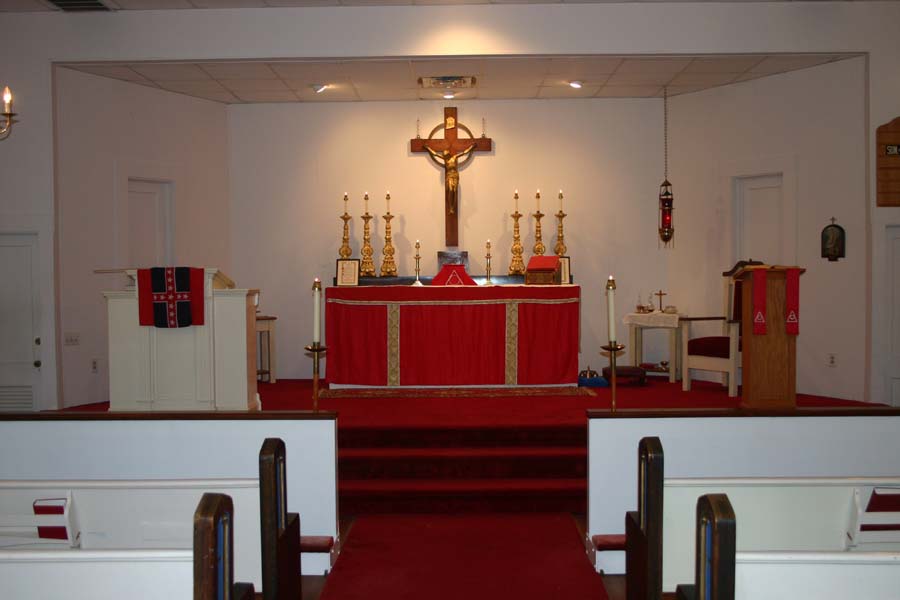
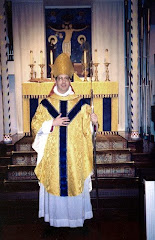
The photo at left is of the sanctuary of St. Hilda of Whitby Anglican Catholic Church in Atlanta, Georgia on June 14th, 2004. The church is vested for the celebration of the feast of a martyr bishop, Blessed Leonidas Polk. June 14th is also the feast of Ss.Anastasius, Felix, and Dignii. They constitute a part of those saints known as the New Martyrs of Cordoba.

Martyed by the Moors at Cordoba about 852. Anastasius was an old priest of Cordoba, Felix was a monk originally out of North Africa, Dignii was a fiery young nun who was ordered killed after she upbraided the Judge in open court for the injustice of the sentences against Father Anastasius and Brother Felix

Another New Martyr of Cordoba is St. Columbii another nun who confronted the authorities directly about the Islamic prohibition on preaching Jesus.

I have in my possession first class relics of Anastasius, Dignii and Columbii.

Saturday, November 11, 2006

My Favorite Anglican Layman

President Dwight Eisenhower wrote the following letter in response to one he received dated August 1, 1960, from Leon W. Scott, a dentist in New Rochelle, New York. Scott's letter reads:

Dear Mr. President:

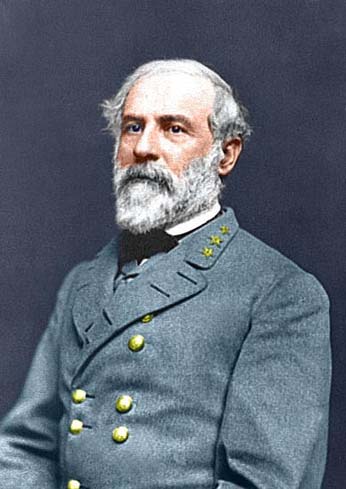
At the Republican Convention I heard you mention that you have the pictures of four (4) great Americans in your office, and that included in these is a picture of Robert E. Lee.

I do not understand how any American can include Robert E. Lee as a
person to be emulated, and why the President of the United States of
America should do so is certainly beyond me.

The most outstanding thing that Robert E. Lee did was to devote his
best efforts to the destruction of the United States Government, and
I am sure that you do not say that a person who tries to destroy our
Government is worthy of being hailed as one of our heroes.

Will you please tell me just why you hold him in such high esteem?

Sincerely yours,

Leon W. Scott

Eisenhower's response, written on White House letterhead, reads as follows:

August 9, 1960

Dear Dr. Scott:

Respecting your August 1 inquiry calling attention to my often
expressed admiration for General Robert E. Lee, I would say, first,
that we need to understand that at the time of the War Between the
States the issue of Secession had remained unresolved for more than
70 years. Men of probity, character, public standing and unquestioned
loyalty, both North and South, had disagreed over this issue as a
matter of principle from the day our Constitution was adopted.

General Robert E. Lee was, in my estimation, one of the supremely
gifted men produced by our Nation. He believed unswervingly in the
Constitutional validity of his cause which until 1865 was still an
arguable question in America; he was thoughtful yet demanding of his
officers and men, forbearing with captured enemies but ingenious,
unrelenting and personally courageous in battle, and never
disheartened by a reverse or obstacle. Through all his many trials,
he remained selfless almost to a fault and unfailing in his belief in
God. Taken altogether, he was noble as a leader and as a man, and
unsullied as I read the pages of our history.

From deep conviction I simply say this: a nation of men of Lee's
caliber would be unconquerable in spirit and soul. Indeed, to the
degree that present-day American youth will strive to emulate his
rare qualities, including his devotion to this land as revealed in
his painstaking efforts to help heal the nation's wounds once the
bitter struggle was over, we, in our own time of danger in a divided
world, will be strengthened and our love of freedom sustained.

Such are the reasons that I proudly display the picture of this great
American on my office wall.

Sincerely,

Dwight D. Eisenhower

Sunday, October 15, 2006

The Last Mass in Hagia Sophia


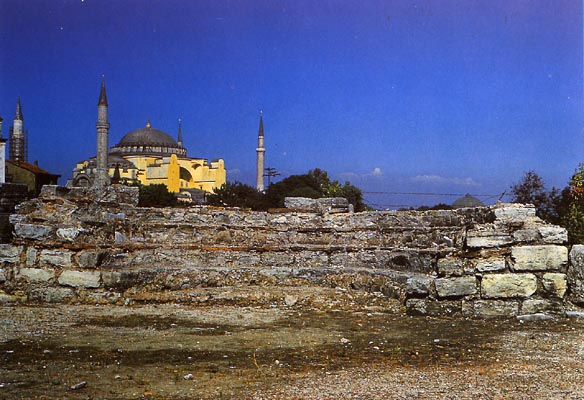
Ruins of church of St. Euphemia looking toward Hagia Sophia (click on photo to enlarge)

The Last Mass in Hagia Sophia

Anonymous Song of Lamentation

for the Fall of Constantinople in 1453.

Translated by Richard Stoneman

God rings the bells, earth rings the bells, the sky itself is ringing,

The Holy Wisdom, the great church, is ringing out the message,

Four hundred sounding boards sound out, and two and sixty bells,

For every bell there is a priest, for every priest a deacon.

To the left the emperor is singing, to the right the patriarch,

And all the columns tremble with the thunder of the chant.

And as the emperor began the hymns to the Cherubim,

A voice came down to them from the sky, from the archangel’s mouth:

"Cease the Cherubic hymn, and let the sacred objects bow;

Priests, take the holy things away, extinguish all the candles:

God’s Will has made our city now into a Turkish city.

But send a message to the West, and let them send three ships:

The first to take the cross, the second to remove the Gospel,

The third, the finest shall rescue for us our holy altar.

Lest it all to those dogs, and they defile it and dishonour it."

The Holy Virgin was distressed, the very icons wept.

"Be calm, beloved lady, be calm and do not weep for them

Though years, though centuries shall pass, they shall be yours again."


Excerpted from:

Greece in Poetry

Simoni Zafiropoulos, ed.

New York: Harry N. Abrams, Inc., Publishers, 1993, p 70.

Sunday, October 08, 2006

Egyptians Persecuted for Turning to Christ

By Gary Lane

For thousands of years, Egyptians have looked to the Nile River for their sustenance. It has provided them with fish to eat and water to irrigate their crops.
Now, in the 21st century, a growing number of Egyptians are searching for living water and a different type of bread.

Many non-believers are coming to Christ by means as diverse as dreams and visions and Christian television broadcasts. As their numbers have increased, so has the persecution against them. And Christians throughout the Middle East are on edge, worried that the violent reaction to the recent words of Pope Benedict may worsen during the Islamic holy month of Ramadan.

Here in Egypt, some fear Christians may fall victim to attacks like the one that occurred last April in Alexandria.

Fakiha Atta tearfully recalls the incident that took the life of her 78-year-old husband Noshi. He failed to return home after a Friday morning church service. She sent her youngest son, Maher, back to the church to fetch him.

When Maher arrived at the church, he noticed a pool of blood at the entrance and a trail of blood leading from the church up the hospital steps next door.

He ran to the hospital emergency room, where he saw doctors and nurses treating a number of church members in blood-soaked clothes. A doctor told Maher that the injured Christians had been stabbed during an attack at the church. Maher says he was shocked after the doctor led him to his deceased father’s bedside.
He told this reporter that no one could possibly know how he felt after seeing his father’s wounds. He says he suffered a mix of emotions—astonishment, sorrow and pain.

Maher wept uncontrollably and wondered how anyone could have murdered his father. His father had no enemies and was loved by everyone.
The Atta Girgis family learned a Muslim radical wielding two long knives stormed into the entrance of the church and stabbed several people while shouting, “god is great!” and “death to infidels!”

Fakiha had been married to Noshi for more than 50 years. How did his murder affect her faith?

“It hasn’t hurt my faith... but, it has affected my life. I feel lonely all the time without my husband and that’s the most difficult part,” Fakiha said.

Christianity has existed in Egypt six centuries longer than Islam, yet Christians are only about 12 percent of the total population. Muslims are about 87 percent.
The country’s constitution gives preference to the Muslim majority, and Christians are often treated as second-class citizens.

Some Christian female teens have been abducted and forced to convert to Islam. Others have been lured or enticed into renouncing their Christian faith by promises of wealth and a more prosperous life as Muslims.

Such was the case for the daughter of peasant farmer Saber Sabeh Gadallah.
As the late autumn sun set over the fields of El Minya, Egypt, farmer Gadallah placed his last few handfuls of hay onto a donkey cart and walked slowly back to his house. The teenage son of his Muslim neighbor asked to purchase some hay. A fatigued Saber instructed his 16-year-old daughter Suzanne to go and fetch the hay from the backyard. She never returned.

Saber explains how an official responded when he went to the police station to file a missing person report. “He slapped my face”, Saber said. “And he yelled, what do you want us to do, put a guard at your house 24 hours per day?”

Saber believes Suzanne was abducted, forcibly converted to Islam and married. Though police may know Suzanne’s location, they have refused to reveal her whereabouts to her parents.

“She’d never do anything like this willingly. She’s very kind, innocent and respectful of her parents,” explained Saber. “If she did this willingly, why will they not let me ask her in person?” Saber says his family has been torn apart. All he wants is for the truth to be revealed.

This former Muslim, we will call her Rachel, says she came to Christ after she fell in love and married a Christian man. We’ve hidden her identity to protect her from attack.

Her family doesn’t know she married a Christian or that she has left the Islamic faith. She is now in hiding because she says family members will murder her if they find out.

It is written in the Koran that they must kill me and take my child,” Rachel said. “They would do it.”

While Egyptian Christians say they expect many trials in the days ahead, their faith is strengthened through sorrow and tears. And some like Rachel say they know God is with them in the midst of their suffering.

Rachel said, “The Lord tells us He cares for the sparrows… just think how much more He cares for us!”

Friday, August 18, 2006

Novena Prayers


Novena of St. Hilda

V. The Lord be with you.

R. And with thy spirit.

Let us pray:

O almighty God who in thy unspeakable providence didst choose Blessed Hilda to be thy instrument in bringing together diverse elements, that where there was discord and division her labours brought harmony and unity, grant we beeseech thee that she, whom we venerate as our patroness, may be our intercessor in Heaven.

Amen.


Litany of St. Hilda


V. Lord have mercy upon us.

R. Christ have mercy upon us.

V. Lord have mercy upon us; Christ hear us.

R. Christ graciously hear us.

V. God the Father of Heaven.

R. have mercy upon us.

V. God the Son Redeemer of the world.

R. have mercy upon us.

V. God the Holy Ghost.

R. have mercy upon us.

V. Holy Trinity, One God.

R. have mercy upon us.

V. Holy Mary.

R. Pray for us.

V. Holy Mother of God.

R. Pray for us.

V. Mother of Christ.

R. Pray for us.

V. Holy Virgin of Virgins.

R. Pray for us.

V. Mother of good counsel.

R. Pray for us.

V. Queen of Virgins.

R. Pray for us.

V. Saint Hilda.

R. Pray for us.

V. Hilda most prudent.

R. Pray for us.

V. Hilda most renowned.

R. Pray for us.

V. Hilda faithful Virgin.

R. Pray for us.

V
. Hilda just leader of her flock.

R. Pray for us.

V. Hilda venerable counselor.

R. Pray for us.

V. Hilda comforter of those in need.

R. Pray for us.

V. Hilda honoured by her peers.

R. Pray for us.

V. Hilda Chaste vessel of unity.

R. Pray for us.

V. Hilda courageous in time of distress.

R.
Pray for us.

V. Hilda obedient to the Holy Rule.

R. Pray for us.

V. Hilda patient in time of affliction.

R. Pray for us.

V. Hilda labourer for harmony.

R. Pray for us.

V. Hilda filled with love of Holy Church.

R. Pray for us.

V. Lamb of God who takest away the sins of the world.

R. Spare us O Lord.

V. Lamb of God who takest away the sins of the world.

R. Graciously hear us O Lord.

V. Lamb of God who takest away the sins of the world.

R. Have mercy upon us.

V. He hath made her mistress of His house.

R. And ruler of all His possessions.

V. The Lord be with you.

R. And with thy spirit.

Let us pray.

Grant we beeseech thee, Almighty God, that we who are afflicted by the burden of discord may by the glorious intercession of thy Abbess, the Virgin Hilda, who through the inspiration of thy Holy Spirit was instrumental in unifying thy Church in England,be brought to the safe harbour of unity and peace and delivered from all adversities and attain to everlasting salvation, through Jesus Christ, Our Lord and God.

R. Amen


This Novena is for Church unity. St. Hilda's in Atlanta has become an expression of that unity in her communicants. They are drawn from the Roman Catholic, Episcopal, and Eastern Orthodox Churches with some Methodists and Presbyterians thrown in for good measure.

Friday, May 12, 2006

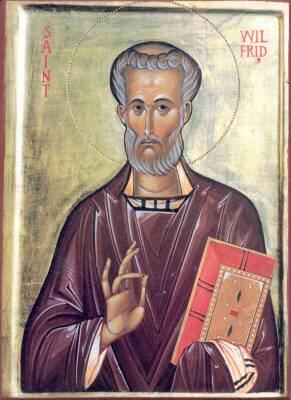
St. Wilfred of York

St. Wilfred of York (pictured at left) is one of the truly outstanding saints of Northumbria. Along with St. Hilda of Whitby he personifies the ancient Celtic Church as described by the Venerable Bede.

He and St. Hilda were on opposite sides of the debate that took place at the synod of Whitby that met to decide what the relationship was to be between the native Celtic Church and the Roman one. Hilda held out for continued independence from Rome while Wilfrid argued for entering into communion with the pope. They agreed completely however in their love of the Celtic Church and the true Gospel.

The compromise that was reached at Whitby was that England would be a dual primacy with the archbishop of Canterbury representing the interests of the pope, and the archbishop of York representing the interests of the native Celtic Church. Wilfrid was chosen to be the first archbishop of York under this arrangement. However it was not long in coming that Wilfrid had to go to Rome to appeal the attempted diminuation of his authority.

The arrangement of dual primacy was preserved until the Norman invasion, sanctioned by the Pope, after which the Duke of Normandy replaced all of the native bishops save one with imported Frankish bishops thus ending by military force the legal arrangement of being in communion with, but not under the direct supervision of the Roman Pontiff.

The See of Rome has through the centuries increased its claims to supremacy. At first claiming authority through Peter and bestowing such titles to the papacy that contained the name of that apostle such as "Throne, or Chair of Peter", "Barque of Peter" etc. But as the centuries passed and the wider Church came to understand that the true head of the Church is Christ, the titles began to change as well. "Vicar of Christ on Earth" was the ultimate appellation self awarded to the office of the pope.

This tactic continues to this day with our new Pope Benedict XVI (I do consider him our Pope even if we are not in communion) jettisoning the title of "Patriarch of the West." This is almost certainly a move designed to set the bishop of Rome apart from the other patriarchs of the ancient Christian Church.

The question of papal authority is the central sticking point in the reunion of orthodox Christendom. The unique claims of the papacy have always been suspect, and like St. Wilfrid and St. Hilda we need to be cautious if and when we enter into arrangements with the Vatican.

The Anglican Use Roman Catholics, for example, have realized too late that there is no mechanism for them to maintain a married clergy except by conversion of already married Anglican clerics. This is why they are desperate to bring over the Continuing Churches to Rome in hope that an Anglican Rite may be created and the deal they have struck with the Roman Church modified. The Anglican Use chapels are slated for absorption into the Roman Communion, destined ultimately to disappear altogether.

Additionally the American, English, Dutch , and German branches of the Roman Catholic Church are hungering and thirsting to go down the same road as the Episcopal Church. In my on line debates with Anglican Use and other Roman Catholics they cannot deny the examples of heresy and apostasy manifested by the Roman Church, they can only claim that they are isolated incidents and the "situation is improving" without citing statistics or trends and certainly not any papal disciplinary actions against the offenders. They are whistling past the graveyard.

So what is the point of this essay? The point is that the Anglican Catholic Church may come to be one of the last repositories of orthodoxy on the planet. That unless the ecumenism we all desire is a positive one, it might kill us. Let us all ask St. Hilda and St. Wilfred to pray that Christ's Church be one in truth and orthodoxy, and that all phony ecumenical efforts be rejected. Heresy is worse than schism.

Sunday, May 07, 2006

Confraternity of St. Hilda


By authority of His Grace, Archbishop Brother John-Charles, the Confraternity of St. Hilda is a Franciscan association of Anglican Catholics who pray for Church unity and the special ministry of women in the Church.

The Confraternity is rooted in the the three Anglican Catholic parishes who have St. Hilda as their patroness. The three parishes are: St. Hilda of Whitby Parish in Atlanta, Georgia, St. Hilda of Whitby Parish in Natchitoches, Louisiana, and St. Hilda of Whitby Parish in Teralba, New South Wales, Australia.

Membership is open to Christians outside of the Anglican Catholic Church as well.

If you want to be enrolled in the Confraternity contact me via this blog, or via the St. Hilda's website at http://www.sthildasacc.org .

Tuesday, May 02, 2006

Many Thanks

Many thanks to all who have prayed for me and my son during our recent kidney transplant surgery. We are doing fine thus far and my son's health seems greatly improved.

Please continue to pray for us.

Also let me know your own prayer intentions, especially those that ask for a healing.

In Christ,
Fr. John

Monday, May 01, 2006

Welcome

Welcome,

Please visit our web pages at http://www.sthildasacc.org. I am interested in hearing your comments on the Anglican Catholic Church.