Tuesday, August 24, 2010

NEW MARTYRS of CORDOBA


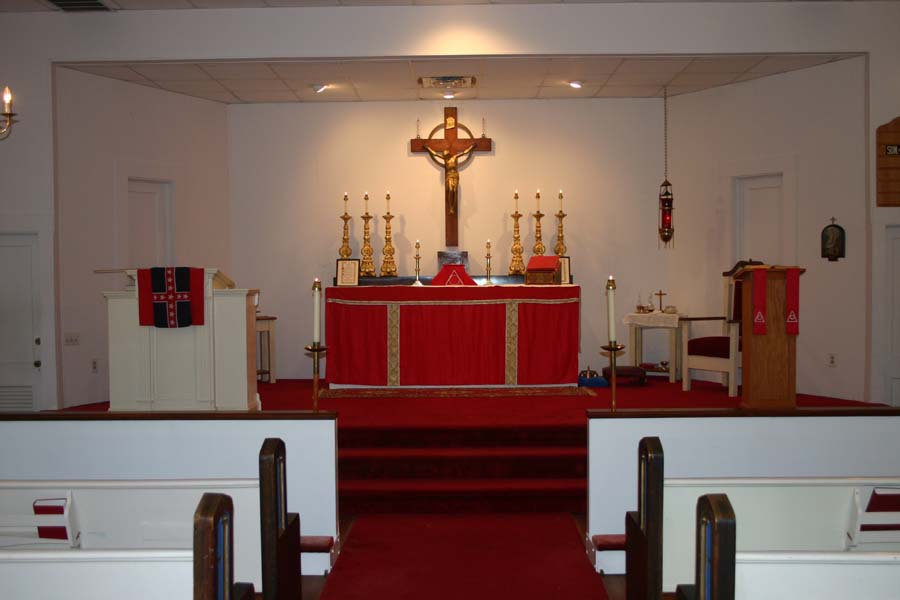
(This article is a reprint from 2006. The building of the Islamic Center in Manhattan near ground zero, ironically called the Cordoba Project, prompts me to rerun this.)The photo above is of the sanctuary of St. Hilda of Whitby Anglican Catholic Church in Atlanta, Georgia on June 14th, 2004. The church is vested for the celebration of the feast of a martyr bishop, Blessed Leonidas Polk. June 14th is also the feast of Ss.Anastasius, Felix, and Dignii. They constitute a part of those saints known as the New Martyrs of Cordoba.

Martyed by the Moors at Cordoba about 852. Anastasius was an old priest of Cordoba, Felix was a monk originally out of North Africa, Dignii was a fiery young nun who was ordered killed after she upbraided the Judge in open court for the injustice of the sentences against Father Anastasius and Brother Felix

Another New Martyr of Cordoba is St. Columbii also a nun who confronted the authorities directly about the Islamic prohibition on preaching Jesus.

I have in my possession first class relics of Anastasius, Dignii and Columbii.

Friday, July 30, 2010

Why the Anglican Catholic Church?


At the risk of beating a dead horse I am posting one more expose' of the strong support given by the United States Conference of Catholic Bishops to the extreme left. This time they are actually funding abortion and the promotion of abortion as a right and also providing political and financial support for the promotion of same sex marriage. As in the past this is an internal expose so the investigators have no agenda to make the Roman Church look bad as they themselves are Roman Catholic zealots. I like these people.

As you listen to the commentator explain the subterfuge involved, those of you who were in the Episcopal Church in the sixties and seventies will have a sense of dejavu. Anglicans thinking about submitting their futures to the uncertainty of who the next pope might be should think again before trading their Anglican birthright for a mess of Roman Catholic pottage. Copy and paste this url into your browser to see the presentation.
http://www.youtube.com/watch?v=tTaW60MNb_g

Saturday, July 24, 2010

Church blasts gay priests leading 'double life'


By NICOLE WINFIELD, Associated Press Writer Nicole Winfield, Associated Press Writer – Fri Jul 23, 2:37 pm ET
ROME – The Catholic Church in Italy, still reeling from the clerical sex abuse scandal, lashed out Friday at gay priests who are leading a double life, urging them to come out of the closet and leave the priesthood.
The Diocese of Rome issued the strongly worded statement after the conservative Panorama newsweekly said in a cover story and accompanying video that it had interviewed three gay priests in Rome and accompanied them to gay clubs and bars and to sexual encounters with strangers, including one in a church building.
Read it all here: http://news.yahoo.com/s/ap/20100723/ap_on_re_eu/eu_italy_gay_priests

Tuesday, July 13, 2010

Sitting in Satan's Lap


My good friend and colleague Dan Cassidy, for whom I have boundless admiration and the highest personal regard, has responded to my posting pointing out the tremendous influence and power that the organized left wields in the Roman Catholic Church, especially in the Roman Seminaries which are in large part dominated, so I and others assert, by a "gay" clique of leftists.

Dan, while not denying that the situation as described here and elsewhere existed in the recent past, has written that the current and previous pope have taken positive steps to ameliorate this state of affairs.

I am posting here a collection of observations on the gayness of the Roman seminaries, some quite old and some quite recent, by various authorities within the Roman hierarchy. Then follows a list of references that contain great detail about the same.

My challenge to Dan and others is to make me believe that the situation as described in these writings no longer exist. Explain to me what concrete and tangible steps have been taken to correct this deplorable state of affairs in the Roman seminaries, show me the measurable impact of the papal reforms.

I can find nothing to refute that many, if not most, Roman seminaries are oppressed by an unwholesome homosexual atmosphere.

Let the reader be the judge.

This from www.religioustolerance.org
Father Donald Cozzens wrote that several studies have concluded that about 50% of priests and seminarians are gay.

David France of Newsweek, referring to St. John's Seminary in Camarillo, CA, wrote: "Depending on whom you ask, gay and bisexual men make up anywhere from 30 percent to 70 percent of the student body at the college and graduate levels."

Rt. Rev. Helmut Hefner, rector of St. Johns Seminary "accepts that his gay enrollment may be as high as 50 percent."

Gay journalist Rex Wockner commented: "When I was in the Catholic seminary in my early 20s (St. Meinrad College, St. Meinrad, Ind., 1982-1983; University of St. Mary of the Lake, Mundelein, Ill., 1983-1984), at least 50 percent of the students were gay....At St. Mary of the Lake, the straight students felt like a minority and felt excluded from some aspects of campus life to such an extent that the administration staged a seminar at which we discussed the problem of the straight students feeling left out of things..."

Author and sociologist James G. Wolfe estimated that 55.1% of seminarians were gay.

Does the gay sub-culture in seminaries affect heterosexual seminarians?
Many priests and theologians have commented about the gay sub-cultures in Catholic seminaries:
An anonymous priest from the Boston area commented in an interview with Joe Fitzgerald of the Boston Herald: "there's a subculture of gay priests and everyone knows it. I went through seminary with a lot of them and got hit on. And when I reported it, I was harassed to a point where, emotionally, it was very difficult to get ordained. I'm not the only one who had to fight to get through it; I know guys who left because of it. It was clear there was a cabal tacitly saying, 'Don't bother reporting this stuff.' You wouldn't believe the self-justifications, like, 'Well, celibacy only applies to not getting married, so since we're not getting married we can do whatever we want.' It was horrible, with a lot of intimidation, but I stayed because I felt this was what God was calling me to do; besides, if I'd walked, they'd have won."

Father McBrien, a theologian at the University of Notre Dame, commented that some seminary students "...who feel they have a genuine vocation for priesthood go into a seminary and feel very alienated by the gay culture. I don't say this in any homophobic sense. It's just the reality."

Pope John Paul II held a meeting with the American cardinals which dealt with the clerical sex scandals. Afterward, Bishop Wilton Gregory, head of the U.S. Conference of Catholic Bishops said: "One of the difficulties we do face in seminary life or recruitment is made possible when there does exist a homosexual atmosphere or dynamic that makes heterosexual men think twice [about entering.] It is an ongoing struggle to make sure the Catholic priesthood is not dominated by homosexual men."

R. Scott Appleby, a history professor at Notre Dame, said: "People I know quite well have left the seminary either in disgust because people are not keeping vows, or in alienation because they’re not gay. In some cases it’s a serious problem."

The Most Rev. Wilton Gregory said: "[T]here does exist a homosexual atmosphere or dynamic that makes heterosexual men think twice."

The Rev. Charles Bouchard, president of the Aquinas Institute of Theology in St. Louis said: "I think straight priests and seminarians shouldn’t be whining. I just don’t think it’s a big deal."

Father Donald Cozzens wrote: "What impact does the gay subcultrue have on the straight priest and seminarian?....straight men in a predominantly or significantly gay environment commonly experience chronic destabilization, a common symptom of which is self doubt...Their psychic confusion, understandably, has significant implications for both their spiritual vitality and emotional balance."

Timothy Radcliffe, Master of the Order of Preachers, commented on the emergence of a homosexual sub-culture within a seminary or religious order: "It can threaten the unity of the community; it can make it harder for the brethren to practice the chastity which we have vowed. It can put pressure on brethren to think of themselves in a way that is not central to their vocation as preachers of the Kingdom..."

References:
The following information sources were used to prepare and update the above essay. The hyperlinks are not necessarily still active today.
1. "Gay Priests," Religion & Ethics Newsweekly, 2002-MAY-10, at: http://www.pbs.org/
3. David France, "Gays and the Seminary," MSNBC, 2002-MAY-20, at: http://www.msnbc.com/
4. "Catholic Seminary Admissions Tighten in Scandal," The Data Lounge, 2002-MAR-27, at: http://www.datalounge.com/
5. "Vatican threatens gay purge of priesthood," The Data Lounge, 2002-MAR-6, at: http://www.datalounge.com/
6. Rex Wockner, "The end of Catholicism in America," PlanetOut, at: http://www.planetout.com/
7. James G. Wolf, "Gay Priests," Harper and Row, 1989, Pages 59-60. Cited in Father Donald Cozzens, "The Changing Face of the Priesthood: A reflection on the priest's crisis of soul," Liturgical Press, (2000), Page 99.
8. Joe Fitzgerald, "Priest fears gays in ranks pose threat to Church," Boston Herald, 2002-MAR-6, at: http://www2.bostonherald.com/
9. Melinda Henneberger, "Pope delivers apology to victims of sex abuse," New York Times, 2002-APR-24, at: http://www.starnews.com/
10. Op Cit, Father Donald Cozzens, Page 101.
11. Timothy Radcliffe, O.P., "The Promise of Life," International Dominican Information, # 361, 1998-APR, special number, A Letter to the Order, Page 96.

Saturday, July 10, 2010

"GAY" ROMAN CATHOLIC SEMINARIES


Pictured at left is the Roman Catholic Bishop of Savannah, Georgia J. Kevin Boland preparing to march in procession at a recent "consecration" of the Episcopal Church. The priest that was being consecrated has performed same sex blessings, but apparently Bishop Boland approves of such since he lent his and the Roman Church's prestige to the event.

In the interest of full disclosure to Anglicans considering accepting the terms of conversion to Roman Catholicism outlined in Anglicanorum Coetibus I am posting excerpts and links to two articles, one from News Week and another from Ignatius Press. The one in News Week is approving of the capture of the Roman Seminaries by organized leftists homosexuals. The one from Ignatius Press is an account from a young man who endured the "gay" atmosphere that was imposed on the seminary.
From News Week By David France
NEWSWEEK

May 20 issue — There will never be a gay students’ group—or gay film series or gay dance—at St. John’s Seminary, one of the most respected training grounds for Catholic priests in the nation.

YET THE 64-YEAR-OLD institution, nestled in the hills of Camarillo, Calif., may be one of the country’s gayest facilities for higher education. Depending on whom you ask, gay and bisexual men make up anywhere from 30 percent to 70 percent of the student body at the college and graduate levels. “I don’t want people to think that in a negative way,” says a 28-year-old gay alumnus, who believes all seminarians there are chaste, regardless of orientation. “It isn’t like Christopher Street or West Hollywood. But some seminarians are gay, openly gay, and very loud about it.”

Though they constitute just over 5 percent of the population, gay men may make up half the student body at the 76 high-school, college and graduate-level seminaries across the country, according to broad estimates. For decades Roman Catholic Church leaders have quietly reckoned with this surprising truth about seminary life. There is no rule against celibate gays as seminarians, theologians say. But for a church where priests preach that homosexuality is an “intrinsic evil,” it is at the least incongruous that so many would-be priests are gay.

Read it all here: http://www.newsweek.com/2002/05/19/gays-and-the-seminary.html


Here follows what the personal experience is like in such an institution.


The Death of a Catholic Seminary
________________________________________
Due to the nature of the information contained in this article, it is necessary to protect the identity of the young author. The seminarian who wrote this story is known to the editor. The following is a truthful account of what has been going on in one of the major seminaries in the United States.
After spending four years in a Neo-Modernist Roman Catholic seminary, I have come to the firm belief that the source of the current crisis in the Church in the United States can be traced directly to the seminaries. The seminary is literally the seedbed of the faith.
Seminary education has traditionally been seen as one of the most important apostolates. Those charged with the formation in seminaries had upon their shoulders a very great responsibility: they were not simply forming a future priest, but the entire Church. Hence, the absolute necessity of quality spiritual and academic formation was clear.
One might argue that this sense has been lost in the torrent of the many erroneous interpretations of the "spirit" of the Second Vatican Council. It is not infrequent that one finds many aberrations in contemporary Catholicism, to the point where many of the faithful, even bishops, are unclear about what the Church really teaches.
Formation for the priesthood has changed drastically in most seminaries since Vatican II. In some seminaries, the changes were well implemented and orthodoxy was retained. In others, disaster followed, and has remained deeply rooted. Many embittered, frustrated priests and nuns continue to work in seminaries with an agenda for "reform" and "change" so that their corporate and personal ambitions and desires can be met. Many want to see priestesses, married clergy, allowance for dissent, and acceptance of homosexual and lesbian lifestyles, and believe the Spirit of the Council called for this kind of "openness" and change. Almost all of them are highly educated and experienced seminary educators.
The kind of formation one receives in seminary depends on the way the particular seminary leadership and faculty interpret the meaning of priesthood, and for that matter, ministry, worship, revelation, and even God himself. With the great political struggles going on deep within the fabric of the Church today, the essential meaning of our very religion is at stake. It is the same when one begins in seminary with the basic question of his vocation to the priesthood.
Because of this divisive crisis, there are now "correct" and "incorrect" ways to talk about priesthood.
Simply a "presider"
The "correct" version may involve a de-emphasis on the word "priest" because it is cultic and exclusive to some. It is more rightly referred to only as "ordained ministry," with an emphasis placed on the fact that some ministries are for regulating power. An "ordained minister" is commissioned in the name of the community to lead that community in worship. The "modernization" of the priest's role means that he is a social worker with religious politics, or a "community animator" with a dynamic personality and flair for drama and entertainment. He may also be simply "a leader of the community, " a "presider" who arranges worship and leads others as a conductor for an orchestra, and also runs the parish as another kind of business. He may also be the "counselor on call" who helps people feel better about themselves. In a time when pride causes us to so easily confuse personal ambition with vocation, it is becoming more and more common to find notions of priesthood that increasingly exclude rich sacramental definitions. Because of the inevitable and increasing envy and jealousy over the priest's unique ontological status and sacramental ministry, there is a mounting movement to demythologize the priesthood and remove its sacred and unique character, and have the priest be essentially no different than anyone else. If others cannot have what he has, then what he has must be removed. If it cannot be removed, it should be watered down.
In the seminary where I went, the more liberal and watered-down definitions of priesthood mentioned above would fall well within the acceptable parameters of a "correct" description of a priestly character. "Social Justice" was the key term to profess at all times. It was in an erroneous interpretation of this term that one could find considerable room within which to form his own notion of priesthood - as long as it maintained a prophetic witness against "unjust structures."
A man would inevitably find trouble, however, if he used language like "the Holy Sacrifice of the Mass." He would have two strikes against him if he in turn stood in opposition to the concept of "priestesses" in the Roman Catholic Church. Such a position would not be respected or looked upon as being even remotely reasonable in light of the experience of "modernity." To think and hold such ideas privately was considered allowable. To hold these things with conviction would not.
The course of formation I experienced, sadly enough, depended heavily upon the guiding principles of political, and especially theological, correctness. These principles controlled the spiritual and academic climate of the seminary institution and its faculty. They were opposed to an adherence (in a spirit of conviction and fidelity) to the authentic teachings of the Church, exhibited through the Holy Father, Magisterium, and Sacred Tradition. The Church's Tradition and traditions were studied from a certain subtle but consistently biased perspective, so that the meaning of many events and personal contributions would be perverted or cast in a negative, offensive light. The spirit of "reform" became most attractive and was perhaps best inculcated after the student could be substantially convinced of the overwhelming "unattractiveness" of the Church's past.
For example, St. Thomas Aquinas was rarely if at all used for our instruction in philosophy or theology. Instead, certain select writings were chosen or referred to for the purpose of exemplifying the limitations of antiquated medieval thought. Particularly underscored were Aquinas's "sexist and demeaning attitudes toward women," and his "erroneous" understanding of human biology. From there it was no difficult task to argue his disqualification from serious contemporary theological discourse. He was consulted as an authority, however, when he was shown to "deny" the Immaculate Conception.
Latin, Greek and Hebrew were deemed irrelevant or useless for the needs of parish ministry, hence these were not part of our seminary training. Patristics were infrequently mentioned and not encouraged, and the lives of the Saints and Doctors of the Church were implicitly written off as antiquated piety. The Rosary was looked upon as being suitable for those without the capacity to approach God intellectually, and it was beneath one of theological sophistication.
Through various erroneous interpretations of the "Spirit of Vatican II," a certain spirit of "sophistication" paved the way for many different "ecclesiologies," not all of which are from Christ. Many are laden with ideologies foreign or contrary to the Gospel. Moral theologies have collapsed into versions of proportionalism anchored vaguely in the "fundamental option" - to the point that mortal sin is nearly impossible to commit, and one may have allowance to live any way he chooses - as long as he is fundamentally "oriented" in the direction of God. An authentic Catholic spirituality of moral discernment may easily collapse into values wedded to the world, naturally heading towards moral and spiritual relativism.
Theological "rigidity"
All of these elements found their way into the fabric of our seminary instruction, one way or another. Even if one did not directly espouse pure relativism, there was still a pervasive, insistent demand for "dialogue" with various perspectives with relativism as a subtle philosophical basis. Faith could venture too close to a seemingly innocent, though mortal, compromise. It didn't seem far from the curb to the gutter. But to hold to "official" teaching, i.e., magisterial documents, was perceived as theological rigidity, disagreeing with certain dubious or erroneous philosophical positions was considered intolerance.
Built upon this drive was the relentless emphasis on the "oppressive and sinful structures" in the world, but perhaps mostly in the Church. This eventually led to the "patriarchy" of Sacred Tradition and contemporary Catholic culture. This form of "oppression" was considered to be the source of many great evils, especially in the Church (not to mention throughout Salvation History). The fury of the radically feminist ego, its lust for power, and ambition for rule was considered justified because of the pain caused by this ancient form of male oppression - as if this form of "activism" was what Christ came to institute. If one were to question how this was supposed to be a vision of good formation for the Catholic Priesthood, that man might find himself cornered with accusations that he was "self-righteous."
In some seminaries, this would not be a problem. The man would be evaluated against certain criteria, some of the most important qualities being personal character, moral fibre, prayer life, and fidelity to Papal and Magisterial teaching. Faculty should be more interested in supporting the teachings of the Holy Father, not dissenting theologians.
In other seminaries however, like the one I attended, this was not so. An attempt to identify the components of the Catholic priest and his spirituality in light of Papal and Magisterial documents, or the Church's traditional Doctors, i.e., St. Alphonsus Liguori, no matter how well articulated, would be deemed "inadequate."
The difference in perspectives was well symbolized by our way of worship. To begin with, we were instructed upon entry to the seminary that we could not kneel at the consecration during Mass, nor could we kneel after receiving communion. This would "break community." We were told that standing was also a posture of reverence on par with kneeling, and that it was more in keeping with Vatican II's "call to mission" of Social Justice - hence standing to be ready to "go out" to enact this justice. Kneeling was considered a "privatistic" worship disconnected from others. It also reflected a repressed piety, a spirituality of "Ghetto Catholicism." This was said to be incompatible with the theology of the Council, and the spirit of the liturgical reforms.
I learned early on that everything done at the seminary had reasoning behind it, although not always good reasoning. The reality behind the theory was that our worship and training were being watered down. We were in practice living a protestantized version of worship. What had always been distinctively Catholic in our Tradition was circumvented, de-emphasized, omitted or excluded. The way we pray is the way we believe.
Inclusive language was the most powerful of all corrosive agents. Not only were the most vocal "justice-conscious" seminarians rewarded for their attacks in class against "insensitive" theological language and oppressive liturgy in the Church's worship, they were considered "courageous men" and commended for their concerns for justice. All through our community Masses, one could not keep from hearing the deliberate and loud references to God in repetitious neutral or even feminine pronouns. The result was the total disruption of the Mass, transforming it from worship to a battle of words.
Collar was sign of "clericalism"
At Mass, the priest was often simply referred to as the "presider." He was the one leading us in prayer, "animating" the community. Many "presiders" improvised upon the Mass, adding their own touch to the eucharistic prayers. Making sure the readings were inclusivized was the responsibility of the reader for the day. The chalice was normally done away with (unless a visiting bishop or dignitary were present), replaced with a standard wine glass. Some priests often would either not attend the daily community Mass, or would cantor instead of concelebrate. Others would just sit in the congregation to show their solidarity with the feminist nuns, typically with their collar undone. The feminist nuns used to give their "communion reflections" (homilies) after the communion song; these were nearly always filled with a spirit of resentment and a call for "reform."
We, as Roman Catholic seminarians, were not allowed to wear clerical clothing. This was because the collar was a sign of "clericalism." Though the rector had been known to tell bishops he did not want to "confuse ministry with the wearing of the collar," the reality behind abolishing the collar in our seminary was that it was a cause of great anxiety for the feminists. In many ways it was, for them, a great symbol of oppression - it was a form of ministry that "excluded" women, and therefore an excessive wearing of the collar was unjust and insensitive.
We were told from the beginning that seminarians were not to refer to any of the faculty as "Father" or "Sister." We were not to be caught up with "titles," as this was another form of clericalism. These things would also offend against the "ecumenical" mission that the seminary was committed to. In terms of a "confusion of ministries," one might question the very practice inculcated in the seminary.
Another divisive factor in the seminary was the reputation of a large homosexual culture. Having gone there for four years, I had seen much that was demoralizing. This was a volatile issue in the seminary, as there were sizeable numbers of men on both sides of the issue. During a class conference, the question that was raised was the unchecked effeminate, scandalous behavior of some seminarians, the negative reputation of the seminary gained by this recurring image, and the kinds of role models the seminary was tacitly approving in recommending these men for orders. The Vice Rector replied by saying the seminary admitted men of both orientations, but the policy was that all had to be celibate. The general split of the house policy was toleration. On the other hand, I did learn through experience that what was not condoned was "intolerance" and "homophobia."
As soon as it was learned that I was one who disliked and criticized such behavior, I was labeled "homophobic." I was even criticized by some seminarians and faculty as being "too masculine." I was concerned what my friends and family would think of the priesthood if I invited them to see where I lived and studied. Because I found these things embarrassing or shameful, many who were charged with evaluating me felt I was the one who had the problem.
Desensitizing occurs
The sad thing is that a man can go into the seminary and be shocked by what he sees, and yet by the time he graduates he may be so desensitized that he may no longer see these things as a problem. It becomes just another facet of "the reality of the Church today." But was everything included in this "reality" of the Church necessarily good and fostered by the Holy Spirit?
Most of the seminary faculty felt my observations and concerns about the seminary to be "judgmental." Therefore, I was dubbed "pastorally insensitive."
To accentuate and build upon these spiritual and moral collapses, the textbooks we used for coursework nurtured and enhanced the growth in our minds of doubt. This brought the seeds of "false doctrines" to complete maturity. It was a hand-in-hand dynamic: the formation would confirm the agenda in the texts, and the agenda in the texts would affirm, enhance, and further strength the sour spirit of formation.
For our entire first academic year, we had to study Richard P. McBrien's Catholicism. This book set the most fertile foundations for doubt and intellectual departure from the true Catholic Faith. It was through subtle and clever deception by veiled, ambiguous language, that McBrien's book was so effective. It became the basis for the reasonableness and goodness of dissent. Some of his more exemplary ideas, implied and cleverly suggested throughout the book, are that we don't have to believe in the virginity of Blessed Mother; that we don't have to believe or assent to follow Church teaching unless it explicitly states it has dogmatic status; and that we must admit to Jesus having been ignorant and in error. McBrien expertly employed his language so that he remained within a "legal" framework, and made outrageous suggestions which to some appear compelling. I recall seeing the firsthand results of this book's use in a discussion I had with another seminarian - he was firmly convinced that "It's totally naive to think that Mary didn't have sex." He was not an isolated case - he was among a common class of seminarian that absorbed the philosophy of McBrien's book. So this seminarian's "openness" and capacity for "dialogue" was lauded; he was considered a "model" seminarian. As far as the spirit of this seminary went, it was permissible to believe as this man did. It was also acceptable to believe that Mary was a virgin; but what was not acceptable was a conviction that our Blessed Mother was always a virgin. To adhere to any orthodox position with fidelity and conviction would be perceived as intolerant of "dialogue," and would reveal some kind of unhealthy "rigidity."
A parallel magisterium
I had an important discussion with the Vice Rector regarding my evaluation, where he criticized my sense of fidelity to the Holy Father's teachings, and my position on the impossibility of priestesses. He said that my position was "inadequate" because the Pope could change the teaching at any time - and since I was so convinced of the impossibility of the ordination of priestesses, he saw that as evidence for my rigidity and how I did not know anything about the levels of authority in the Church. "When the Pope changes tomorrow," he said "and decides to ordain women - then where will your 'fidelity' be? Will you change also, or will you be a source of division in the parish? This is our concern with you."
Although the seminary faculty believed they did "technically" teach what the Church teaches, the reality was that they taught a version - and most seminarians innocent or ignorant of authentic Church teaching would have no reason to believe otherwise. Church teaching would be mentioned, but it was always "nuanced" or muted, or given a relative status with other, liberal theologians. A parallel magisterium of popular liberal theologians was often presented and considered with equal authority. We often studied Protestant theologies right alongside Rahner, Schillebeeckx, Kung, Boff (even on occasion Matthew Fox) and so forth. Since there was no reliance upon the Magisterium for guidance or point of reference in most theological discussions, we seminarians would be adrift in a sea of opinion and interpretations, both Protestant and Catholic. To bring Magisterial positions into a "serious theological discussion" was somehow an offense to "academic freedom" and was thus perceived as an insult.
The study of moral theology was characterized by Charles Curran and the fundamental option, proportionalism and the subtle ridicule of traditional moral theologies. Papal encyclicals and theologians like Thomas Aquinas and Alphonsus Liguori were bumped because they were "old," and because of a few examples of apparent contradiction in their writings, chosen without appropriate and necessary contextualization. The impression was that the Pope was very fallible, traditional theologies were irrelevant or ridiculous in light of modern science and psychology, and the Magisterium was an agent of the Vatican for control over theological discussion. The components that were attacked were precisely those pillars preventing the various agendas of "the world" from entering and taking root in the mind and heart of the Church.
Confronted with a choice
In the area of spirituality, we had workshops on "women's spirituality," or something about "collaborative ministry" and "social justice," because this was perceived as "where the Spirit was" in today's world. Devotion to Mary as "Blessed Mother" was allowed, but generally not encouraged, as such a "servile" image and traditional feminine values were seen by many as not in keeping with feminist theology and the "contemporary experience of women." The Rosary, prayed in the main chapel by a group of seminarians, was tolerated for a time. But eventually the tension created in the seminary over this group brought it to an end. However, to please bishops, and as a kind of token gesture to the conservative element in the seminary, the Rosary was suddenly allowed again - with official seminary approval - but then only in a small hall chapel where there was no Blessed Sacrament, one day a week, between breakfast and classes. The reason behind not allowing the Rosary in the main chapel was that "the chapel is for liturgical celebrations - not devotions." And yet the chapel was used for a number of functions outside Catholic worship, including on occasion the rehearsals of a local symphony orchestra.
The greatest of spiritual tests came in my fourth year, in a course of so-called "Pastoral Counseling. " A laywoman with a very vocal agenda taught the course. Not only did she proudly inform us one day that she'd be taking off a class to attend the Call to Action seminars in Chicago (where everyone joined in the Eucharistic prayers as a woman in stole "presided"-and with a Catholic Bishop in the congregation), but she openly canvassed for gay and lesbian rights, radical feminism, and even abortion. Because I openly questioned this woman's arguments, I was penalized. To add to the irony, I was paid a visit by the Vice Rector, who wanted an explanation as to the reasons for my "making trouble" in her class.
My question to the faculty of the seminary involved whether it was formation we were receiving, or deformation. And, in turn, the question the faculty put to me was whether I was "open to where the Church is going today." But was doctrinal confusion, homosexuality, feminist anger and destruction of the priesthood where the Holy Spirit was truly leading us?
Through a discouraging dilemma, I knew that what was being taught directly contradicted what the Church taught, and I knew that the bishop in my home diocese supported me. He always expressed support of my orthodox values and beliefs, and told me on more than one occasion, "Remember I'm the one who ordains you, not they."
After four years in the seminary of standing up for what was right, I was finally punished with dismissal. I was asked to leave at the end of the academic year and to not return. Even though I was pointing out direct cases where the seminary stood contrary to Catholicism in its spiritual climate, members of the faculty protected themselves and the institution by making it appear I was the one who opposed the Church, her authority, and seminary formation.
I did not compromise what I believed and knew to be true. It was no longer a question of being prudently silent here and there when necessary. Rather, I was being directly confronted with a choice: either I had to admit to the problems being mine, which would in turn mean seeing a therapist, or hold fast to what I knew to be the truth. If I didn't answer "correctly," if I continued to maintain my position, I would certainly be voted down as a candidate for Holy Orders.
I was called into board meetings and forced to answer to charges of being "narrow," "rigid," "not open to dialogue," "having problems with women," "not trusting of the faculty," and "combative."
In order, these things were reactions to the truth - "narrow" was another way of saying I was too much the "papist" in my thinking, and that I couldn't appreciate other "ecclesiologies." "Rigid" meant that I would not compromise the teachings of the Church, or water them down to accommodate theological correctness. "Not open to dialogue" meant that I did not entertain dissent as an option in my faith. "Having problems with women" simply meant that I was critical of feminism and feminist theology, and the feminist agendas being forced on me. "Not trusting the faculty" referred to my wariness around the thick duplicity I encountered in my dealings with nearly all the faculty at the seminary. It was wise to maintain prudence in what one told a frustrated liberal faculty member who asks pointed and probing questions, because it somehow always became "incriminating evidence" during evaluations.
If I were to deny my faith -what I believed to be true about the Church, indeed what all orthodox Catholics and even the Pope himself believes and teaches - I would in effect be denying Christ, the Church's Author and Bridegroom.
Because of the ramifications of the rector's rage, and to my surprise, the bishop in turn also "released" me, as the matter had become quite political for him. The man who once told me in private not to compromise my beliefs compromised me, even after I had made him aware of everything I experienced at the seminary through letters. I was disappointed that he declined to intervene on my behalf, and that he could look the other way after all I had told him. He compromised because he did not want confrontations with a pandora's box.
I began to think long and hard about the substance of faith. I knew that the price to pay for faith in our Church's history was sometimes death. The early Christians arrested by the Romans faced such a situation: all they had to do was deny Christ and burn incense to the gods. They could then go free. They could have done this and continued to worship in the privacy of their hearts. But they knew that a faith existing in the heart must also be professed on the lips - it could not be compromised. The reality of what was at stake was all too clear for them, and therefore compromise was unthinkable. I wondered if, in seminaries like the one I attended, men are in a sense still being placed before the images of various gods and told to make a choice. After the first few compromises are made, the rest are easy.
Perhaps the burning of incense to the gods is more common now than in centuries past. The externals may have changed, so we are fooled into thinking such situations no longer occur. And so they happen all the more. Today, compromise is not only permitted, it is a way of life. We don't want to "offend" anyone, and we don't want confrontations.
Let the fruits speak for themselves as we look into the history of our Catholic conscience and find the incense of compromise now billowing in the halls of Christ's seminaries.
Published in the May '95 issue of The Homiletic & Pastoral Review
Homiletic & Pastoral Review

Monday, June 07, 2010

Chief Roman Military Chaplain Broglio Opposes Repeal of "Don't Ask, Don't Tell"


Every year Western civilization becomes more enmeshed in secular humanism and less connected with Christian morality. The end result will not be more freedom, but anarchy. A confused, angry, hurting world of broken people with no real family ties, one that glorifies and praises a life of selfish hedonism, a life that calls no one to try to live to a higher standard or to do their duty. A life devoted to the pursuit of a personal happiness that destroys the foundational institution of all free republics, the family.

Here follows a letter from Roman Catholic Archbishop Timothy Broglio, pictured above, concerning the impact on faithful Catholics (both Roman and Anglican ones)if the "don't ask don't tell" law governing homosexuality in the Armed Forces is repealed.


Archbishop's Broglio's Letter:


June 1, 2010
In a response to a request from the Chiefs of Chaplains of the Armed Forces I communicated some considerations and concerns regarding the proposal to change the existing legislation regarding persons with a homosexual orientation in the military. In fulfilling my role as the chief shepherd of Catholics in the United States Armed Forces, I have had the opportunity of visiting many installations in the recent past. A number of chaplains and commanding officers have expressed concerns about the effects of a change. There is a request for guidance.
The teaching of the Catholic Church is clearly expressed in the Catechism of the Catholic Church:

2357 Homosexuality refers to relations between men or between women who experience an exclusive or predominant sexual attraction toward persons of the same sex. It has taken a great variety of forms through the centuries and in different cultures. Its psychological genesis remains largely unexplained. Basing itself on Sacred Scripture, which presents homosexual acts as acts of grave depravity,140 tradition has always declared that "homosexual acts are intrinsically disordered."141 They are contrary to the natural law. They close the sexual act to the gift of life. They do not proceed from a genuine affective and sexual complementarity. Under no circumstances can they be approved.

2358 The number of men and women who have deep-seated homosexual tendencies is not negligible. This inclination, which is objectively disordered, constitutes for most of them a trial. They must be accepted with respect, compassion, and sensitivity. Every sign of unjust discrimination in their regard should be avoided. These persons are called to fulfill God's will in their lives and, if they are Christians, to unite to the sacrifice of the Lord's Cross the difficulties they may encounter from their condition.

2359 Homosexual persons are called to chastity. By the virtues of self-mastery that teach them inner freedom, at times by the support of disinterested friendship, by prayer and sacramental grace, they can and should gradually and resolutely approach Christian perfection.

Consequently, those with a homosexual orientation can expect respect and treatment worthy of their human dignity. The prohibitions regarding sexual harassment and intimidation refer just as much to homosexuals as to anyone else. However, unions between individuals of the same gender resembling marriage will not be accepted or blessed by Catholic chaplains. Furthermore no restrictions or limitations on the teaching of Catholic morality can be accepted. First Amendment rights regarding the free exercise of religion must be respected.
This means that Catholic chaplains must show compassion for persons with a homosexual orientation, but can never condone—even silently—homosexual behavior. A change might have a negative effect on the role of the chaplain not only in the pulpit, but also in the classroom, in the barracks, and in the office.
A more fundamental question, however, should be raised. What exactly is the meaning of a change? No one can deny that persons with a homosexual orientation are already in the military. Does the proposed change authorize these individuals to engage in activities considered immoral not only by the Catholic Church, but also by many other religious groups? Will there be changes in the living conditions, especially in the AOR?
There is no doubt that morality and the corresponding good moral decisions have an effect on unit cohesion and the overall morale of the troops and effectiveness of the mission. This Archdiocese exists to serve those who serve and it assists them by advocating moral behavior. The military must find ways to promote that behavior and develop strong prohibitions against any immoral activity that would jeopardize morale, good morals, unit cohesion and every other factor that weakens the mission. So also must a firm effort be made to avoid any injustices that may inadvertently develop because individuals or groups are put in living situations that are an affront to good common sense.
I think that those questions require an adequate response. The effect of a repeal of the current legislation has the potential of being enormous and overwhelming. Nothing should be changed until there is certainty that morale will not suffer. Sacrificing the moral beliefs of individuals or their living conditions to respond to merely political considerations is neither just nor prudent especially for the armed forces at a time of war. Catholics believe that nothing will be done if there is a careful and prudent evaluation of the effects of a change.
For years, those struggling with alcoholism have benefitted from Alcoholics Anonymous. Like homosexuality, there is rarely a cure. There is a control through a process, which is guarded by absolute secrecy. It is an equivalent to “Don’t ask don’t tell”. The process has worked well for some time without the charge that it is discriminatory.
The Archdiocese for the Military Services—the only jurisdiction charged with the pastoral care of all Catholics in the military, VA Administration, and at the service of the Federal Government outside of the boundaries of the United States, which is also charged with endorsing Roman Catholic priests urges the Congress not to repeal the current policy for the Armed Forces.

Archbishop Timothy Broglio

Archbishop for the Military Services USA

Saturday, June 05, 2010

Coming Soon to a Neighborhood Near You


The political agenda of the liberals, progressives, Marxists, Trotskyists, or whatever they choose to call themselves this year is clearly one supported by TEC, in fact one could say that organization is on the cutting edge of the social revolution that had its origins in Marxism.

The United Kingdom is light years ahead of us in progressive laws as the tape at the bottom of this posting demonstrates. This is what TEC wants for the U.S., swift arrest for anyone who disagrees with them on the issue of Christian teaching on the correct use of our sexuality. Other public utterances also call for arrest, so be careful what you say to someone, even in a private exchange, when in the UK. The two ministers in this tape are not in your face or belligerent at all, the offending remark was made privately by one of the two in answer to a private query from one of the listeners, someone overheard the remark and called the police. Click on the You Tube url below for a glimpse of things to come.

Many on the left, even so-called moderates, favor these types of laws for the U.S.

http://www.youtube.com/user/christianorguk#p/u/0/12LtOKQ8U7c

Thursday, May 27, 2010

SLIPPERY SLOPE THEOLOGY


People and organizations looking for new members,or networking opportunities often send me emails because the words "anglican," "catholic" and "priest" appear in my email address. Today I received a notice from a Lutheran church located not far away from St. Hilda's. I suppose that the text was written for insiders because of its frank admission that the members of the parish, or at least the ones with the power, admit that they are acting as a "change agent." Here follows their notice:
[Sunday, June 13, the community of St. John's Lutheran Church , 1410 Ponce de Leon Ave. , will gather at 10:30 a.m. to affirm it's calling to be a congregation of love, welcome, and service with a special Affirmation of Christian Ministry liturgy. Recognizing its role as a change agent in the ELCA, St. John’s looks forward to claiming a role as a more diverse community, to be an agent of reconciliation for people who are struggling with the changes, and to be positive participant in the Southeastern Synod. The Rev. Jane Fahey, pastor at Druid Hills Presbyterian Church, will preach. Pastor Brad Schmeling starts a new Bible study series June 2, Wednesday nights at 7.]
The first question that comes to my mind upon reading this is, if the ELCA has been wrong for all these centuries in such a profound way about the scriptural teachings regarding the correct use of our sexuality, then what else might she be in error on?

It is better to not belong to such an uncertain church. In such an environment all belief is up for change. When the ultimate theological question is asked, "What think ye of Christ, whose son is he?" You will be amazed at the answers you will get from this crowd.

Tuesday, May 11, 2010

Leonidas Polk Memorial Services June 19, 2010 10:00 a.m. at Pine Mountain 6:00 p.m. at St. Hilda’s Church

The Polk SCV Camp of Smyrna and St. Hilda’s Church will conduct two memorials for Bishop-General Leonidas Polk on Saturday, June 19, 2010. The first service will be held at Pine Mountain at 10:00 a.m. The second service will be at St. Hilda’s Church at 6:00 p.m. Go to www.sthildasacc.org for directions to Pine Mountain and the Church.
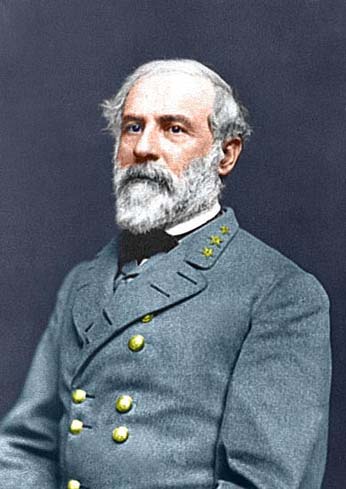
The services commemorate the bishop’s life-long dedication to Christ and the church, as well as his sacrifice for our country. As a Confederate corps commander, General Polk fell in battle at Pine Mountain, Georgia on June 14, 1864.
All are encouraged to join the Polk Camp and St. Hilda’s Church in honoring this brave Christian soldier. Immediately after the 6:00 p.m. service, St. Hilda’s will host a reception. Donations welcome! Period dress encouraged.

Monday, May 10, 2010

Slippery Slope in Vienna

A recent news article reports that an Austrian cardinal has advised that the "quality of homosexual relationships should be examined." He also comments that people hardly marry anymore, so what's the big deal about same sex coupling and divorce? You can read it all here http://www.lifesitenews.com/ldn/2010/may/10051004.html . Someone should tell the Cardinal that most folks, especially in Europe, don't bother to go to church anymore either. With Roman Cardinals like this why bother.

Saturday, March 13, 2010

Caught in the Middle


In the latest issue of “The Latin Mass” magazine Editor in Chief John W. Blewit made the following remarks; “…the USCCB has returned to its usual bureaucratic form in taking on a political issue that is best left to the deliberations of elected politicians. The U.S. Bishops have announced a campaign to mobilize (Roman) Catholics for comprehensive immigration reform led by Bishops of Salt Lake City, Utah and Albany, New York. Their committee includes two nuns-one a sister of Notre Dame from Cleveland, Ohio, and the other a Sister of Saint Joseph from Philadelphia, Pennsylvania- and a staff member of the USCCB. This self-serving and politically correct committee is bound to increase the number of meetings for the bureaucrats in the Church, if that’s possible.”

And; “Pope Benedict XVI has taken the initiative to entice Anglican traditionalists (an oxymoron to say the least) to convert to Roman Catholicism. This gesture on the part of Pope Benedict prompted Austen Lueveigh, a former adviser to the Roman Catholic Archbishop of Westminster, to comment that the Pope’s announcement is ‘historic because it allowed for the gradual absorption into the Roman Catholic Church huge numbers of Anglicans who are conservative in their Theology and Liturgy.’ What Pope Benedict has done with his new provisions allows groups of Anglicans from around the world to join new parishes headed by former Anglican prelates who will provide spiritual guidance to Anglicans who wish to be Roman Catholics. Called “personal ordinariates” they will be established within local Roman Catholic dioceses.”

I respect traditional Roman Catholics (not an oxymoron in my book) and wish them God's blessing. I also appreciate “Latin Mass” magazine pointing out that those who join Rome will be “former Anglicans.”

Tuesday, December 29, 2009

Affirmation of St. Louis

The late Bishop Albert Chambers, shown at left, consecrated bishops for the Continuing Anglicans who adopted the Affirmation of St. Louis in 1977. We are asking Anglicans to recommit themselves to the Affirmation by leaving their names at the url underneath the Bishop's photo.
http://affirmationofstlouis.blogspot.com/

Wednesday, December 02, 2009

"Dr. Fundamentalis": H. L. Mencken's Obituary of Machen


The Rev. J. Gresham Machen, D.D., who died out in North Dakota on New Year's Day [editor's note: 1937], got, on the whole, a bad press while he lived, and even his obituaries did much less than justice to him. To newspaper reporters, as to other antinomians, a combat between Christians over a matter of dogma is essentially a comic affair, and in consequence Dr. Machen's heroic struggles to save Calvinism in the Republic were usually depicted in ribald, or, at all events, in somewhat skeptical terms. The generality of readers, I suppose, gathered thereby the notion that he was simply another Fundamentalist on the order of William Jennings Bryan and the simian faithful of Appalachia. But he was actually a man of great learning, and, what is more, of sharp intelligence.

What caused him to quit the Princeton Theological Seminary and found a seminary of his own was his complete inability, as a theologian, to square the disingenuous evasions of Modernism with the fundamentals of Christian doctrine. He saw clearly that the only effects that could follow diluting and polluting Christianity in the Modernist manner would be its complete abandonment and ruin. Either it was true or it was not true. If, as he believed, it was true, then there could be no compromise with persons who sought to whittle away its essential postulates, however respectable their motives.

Thus he fell out with the reformers who have been trying, in late years, to convert the Presbyterian Church into a kind of literary and social club, devoted vaguely to good works. Most of the other Protestant churches have gone the same way, but Dr. Machen's attention, as a Presbyterian, was naturally concentrated upon his own connection. His one and only purpose was to hold it [the Church] resolutely to what he conceived to be the true faith. When that enterprise met with opposition he fought vigorously, and though he lost in the end and was forced out of Princeton it must be manifest that he marched off to Philadelphia with all the honors of war.

II
My interest in Dr. Machen while he lived, though it was large, was not personal, for I never had the honor of meeting him. Moreover, the doctrine that he preached seemed to me, and still seems to me, to be excessively dubious. I stand much more chance of being converted to spiritualism, to Christian Science or even to the New Deal than to Calvinism, which occupies a place, in my cabinet of private horrors, but little removed from that of cannibalism. But Dr. Machen had the same clear right to believe in it that I have to disbelieve in it, and though I could not yield to his reasoning I could at least admire, and did greatly admire, his remarkable clarity and cogency as an apologist, allowing him his primary assumptions.

These assumptions were also made, at least in theory, by his opponents, and thereby he had them by the ear. Claiming to be Christian, as he was, and of the Calvinist persuasion, they endeavored fatuously to get rid of all the inescapable implications of their position. On the one hand they sought to retain membership in the fellowship of the faithful, but on the other hand they presumed to repeal and reenact with amendments the body of doctrine on which that fellowship rested. In particular, they essayed to overhaul the scriptural authority which lay at the bottom of the whole matter, retaining what coincided with their private notions and rejecting whatever upset them.

Upon this contumacy Dr. Machen fell with loud shouts of alarm. He denied absolutely that anyone had a right to revise and sophisticate Holy Writ. Either it was the Word of God or it was not the Word of God, and if it was, then it was equally authoritative in all its details, and had to be accepted or rejected as a whole. Anyone was free to reject it, but no one was free to mutilate it or to read things into it that were not there. Thus the issue with the Modernists was clearly joined, and Dr. Machen argued them quite out of court, and sent them scurrying back to their literary and sociological Kaffeeklatsche. His operations, to be sure, did not prove that Holy Writ was infallible either as history or as theology, but they at least disposed of those who proposed to read it as they might read a newspaper, believing what they chose and rejecting what they chose.

III
In his own position there was never the least shadow of inconsistency. When the Prohibition imbecility fell upon the country, and a multitude of theological quacks, including not a few eminent Presbyterians, sought to read support for it into the New Testament, he attacked them with great vigor, and routed them easily. He not only proved that there was nothing in the teachings of Jesus to support so monstrous a folly; he proved abundantly that the known teachings of Jesus were unalterably against it. And having set forth that proof, he refused, as a convinced and honest Christian, to have anything to do with the dry jehad.

This rebellion against a craze that now seems so incredible and so far away was not the chief cause of his break with his ecclesiastical superiors, but it was probably responsible for a large part of their extraordinary dudgeon against him. The Presbyterian Church, like the other evangelical churches, was taken for a dizzy ride by Prohibition. Led into the heresy by fanatics of low mental visibility, it presently found itself cheek by jowl with all sorts of criminals, and fast losing the respect of sensible people. Its bigwigs thus became extremely jumpy on the subject, and resented bitterly every exposure of their lamentable folly.

The fantastic William Jennings Bryan, in his day the country's most distinguished Presbyterian layman, was against Dr. Machen on the issue of Prohibition but with him on the issue of Modernism. But Bryan's support, of course, was of little value or consolation to so intelligent a man. Bryan was a Fundamentalist of the Tennessee or barnyard school. His theological ideas were those of a somewhat backward child of 8, and his defense of Holy Writ at Dayton during the Scopes trial was so ignorant and stupid that it must have given Dr. Machen a great deal of pain. Dr. Machen himself was to Bryan as the Matterhorn is to a wart. His Biblical studies had been wide and deep, and he was familiar with the almost interminable literature of the subject. Moreover, he was an adept theologian, and had a wealth of professional knowledge to support his ideas. Bryan could only bawl.

IV
It is my belief, as a friendly neutral in all such high and ghostly matters, that the body of doctrine known as Modernism is completely incompatible, not only with anything rationally describable as Christianity, but also with anything deserving to pass as religion in general. Religion, if it is to retain any genuine significance, can never be reduced to a series of sweet attitudes, possible to anyone not actually in jail for felony. It is, on the contrary, a corpus of powerful and profound convictions, many of them not open to logical analysis. Its inherent improbabilities are not sources of weakness to it, but of strength. It is potent in a man in proportion as he is willing to reject all overt evidences, and accept its fundamental postulates, however unprovable they may be by secular means, as massive and incontrovertible facts.

These postulates, at least in the Western world, have been challenged in recent years on many grounds, and in consequence there has been a considerable decline in religious belief. There was a time, two or three centuries ago, when the overwhelming majority of educated men were believers, but that is apparently true no longer. Indeed, it is my impression that at least two-thirds of them are now frank skeptics. But it is one thing to reject religion altogether, and quite another thing to try to save it by pumping out of it all its essential substance, leaving it in the equivocal position of a sort of pseudo-science, comparable to graphology, "education," or osteopathy.

That, it seems to me, is what the Modernists have done, no doubt with the best intentions in the world. They have tried to get rid of all the logical difficulties of religion, and yet preserve a generally pious cast of mind. It is a vain enterprise. What they have left, once they have achieved their imprudent scavenging, is hardly more than a row of hollow platitudes, as empty as [of] psychological force and effect as so many nursery rhymes. They may be good people and they may even be contented and happy, but they are no more religious than Dr. Einstein. Religion is something else again--in Henrik Ibsen's phrase, something far more deep-down-diving and mudupbringing, Dr. Machen tried to impress that obvious fact upon his fellow adherents of the Geneva Mohammed. He failed--but he was undoubtedly right.
____________
From the Baltimore Evening Sun (January 18, 1937), 2nd Section, p. 15.

Tuesday, June 02, 2009

Letter from Archbishop Haverland to Bishop Duncan

20 May 2009. Vigil of the Ascension


Dear Bishop Duncan,


I thank you for your invitation to attend as an observer the inaugural Provincial Assembly of the Anglican Church in North America, which is to gather in Bedford, Texas, from June 22nd to 25th. I congratulate those who will assemble on their movement out of the Episcopal Church. Whatever else we agree or disagree about, we believe that that movement is correct.


Those of us who left the Episcopal Church and Anglican Communion a generation ago believe that the ordination of women was then the central problem in the Canterbury Communion. The notion that women can receive the sacrament of Holy Orders in any of its three parts constitutes, in our view, a revolutionary and false claim: a claim false in itself; a claim destructive of the common ministry that once united Anglicans; and, finally, a claim productive of an even broader and worse consequence. That worse consequence is the claim that Anglicans have authority to alter important matters of faith and order against a clear consensus in the central tradition of Catholic and Orthodox Christendom. Once such a claim is made it may be pressed into service to alter any matter of faith or morals. The revolution devours its children. Many of the clergy represented at GAFCON and now joining the ACNA seem to us to accept the flawed premise and its revolutionary claim in one matter while seeking to resist the application of the premise in the matter of homosexuality. This position seems to us to be internally inconsistent and impossible to sustain successfully over time.


In brief, then, we would suggest that the only sound basis for Continuing Anglican life is something akin to that already established in the Affirmation of Saint Louis with its clarity concerning the subordination of all Anglican authorities to the central tradition of Christendom.


We make this suggestion with a strong recognition of our own personal and ecclesial failures. But the failure of the Continuing Churches to unite and grow sufficiently does not at all alter the cogency of our observations about your own fundamental principles. Our own history teaches us that anything other than clear agreement on all significant doctrinal issues at the outset will lead eventually to division and decline.


To put matters another way, already now at the beginning of your enterprise, your dioceses and bishops are only in a state of impaired communion with each other. Some of your bishops do not recognize the validity of the priestly ministry of a significant body of clergy in other dioceses. Such divisions and problems at the beginning will not resolve themselves in time, but rather will grow. Ambiguity, or local option, or silence cannot undo the damage of essential disagreement concerning Holy Orders and authority in the Church.


In summary, then, we see in the ACNA the fundamental alterations in traditional Anglican faith, worship, order, and practice that led to the formation of our own Continuing Church in 1978. We would be glad to establish conversations with your ecclesial body in hopes that you may, having freed yourselves of the Episcopal Church, continue further on the same path by decisively breaking from a corrupt Anglican Communion and by returning to the central tradition of Christendom in all matters, including the male character of Holy Orders, the evil of abortion, and the indissolubility of sacramental marriage. We recommend to your prayerful attention the Affirmation of Saint Louis, which we firmly believe provides a sound basis for a renewed and fulfilled Anglicanism on our continent.


We suspect that any Anglican body that permits the ordination of women, or otherwise fails to return to the central tradition of Christendom, will soon move from what we might call neo-Anglicanism, which is already removed in ministry and worship from classical Anglicanism, and will eventually merge into the general stream of evangelical Protestantism. While faithful Protestantism of that sort is far preferable to what the Episcopal Church has become, it is not the Catholic Faith which we hold, it is not the Anglicanism that formed us, and it does not seem to us to have a bright future.


We have already communicated with persons in the ACNA about the Anglican Catholic Church's prior use of the name you have adopted (ACNA). We are certain that this matter can be successfully resolved to our mutual satisfaction, but pending such resolution we do note our prior use.


I fear that this letter in response to your kind invitation may seem somewhat abrupt. I do not mean it to be such. I wish instead to indicate clearly that our first principles seem to be very different. A fruitful dialogue would need to begin with those principles, and the plans outlined in your letter for the Bedford meeting do not seem to encompass such fundamental questions. I would be happy, however, to assist in the establishment of such dialogue in the future if the ACNA is not wedded to its position on the ordination of women and the authority of Anglican bodies to alter matters of faith and order.


With all good wishes, I am,

Faithfully yours in Christ,


(The Most Reverend) Mark Haverland, Ph.D.

Acting Primate, Anglican Catholic Church

Monday, May 04, 2009

St. Hilda's In the Snow


An early March snow storm blankets Atlanta, Georgia in 2009 turning St. Hilda's Church into a Christmas greeting card.

Monday, April 27, 2009

Iraqi archbishop decries Christian slayings

Archbishop Sako shown above
AP

By YAHYA BARZANJI, Associated Press Writer Yahya Barzanji, Associated Press Writer – Mon Apr 27, 2:58 pm ET

KIRKUK, Iraq – At two Christian homes, the gunmen used the same methods: point-blank fire that claimed three lives in a 30-minute span. The attacks left another outpost of Iraq's dwindling Christian community frightened Monday that it could become caught in the struggles over disputed Kirkuk.

"Innocent people who have no relation with politics and never harmed anyone were killed by terrorists in their homes just because they were Christians," Chaldean Archbishop Louis Sako told more than 600 mourners in this ethnically mixed city 180 miles north of the capital.

The motives behind the late Sunday attacks remained unclear, with suspicions mostly falling on Sunni insurgents linked to al-Qaida in Iraq.

But fear of reprisals and worries about vulnerability have become common themes for members of one of the world's oldest Christian homelands.

Iraq's Christians, who numbered about 1 million in the early 1980s, are now estimated at about half that as families flee warfare and extremist attacks that target their churches and homes.

The future of Kirkuk — an ethnic patchwork led by Kurds and Arabs — has become one of the most politically sensitive issues for Iraqi leaders and for U.S. military commanders preparing to withdraw their troops by the end of 2011.

The city is the hub of Iraq's northern oil fields and a key prize for both Kurds and the central government in Baghdad. The showdown is so volatile that Kirkuk was excluded from regional elections in January and the United Nations has offered a proposal for compromise plans.

Caught in between are the smaller communities of ethnic Turks and Christians, including the ancient branches of Chaldean and Assyrian churches and smaller communities such as Roman Catholics and Orthodox.

Speaking to mourners at Kirkuk's main Chaldean church, Sako blamed political leaders for failing to reach compromises on the many ethnic and political disputes.

"It seems that violence is coming back and they lost that chance," he said.

Two of the victims were Chaldean Christians; the other was Assyrian. Family members said all would be buried in their home areas around Mosul, Iraq's third-largest city 225 miles northwest of Baghdad.

Kirkuk police Lt. Col. Anwar Qadir said the slayings appeared to be an attempt by al-Qaida to spark sectarian clashes or scare away the more than 10,000 Christians remaining around Kirkuk.

In the past, insurgents have described Iraq's Christians as "crusaders" whose true loyalty lies with U.S. troops and the West.

On Monday, round-the-clock security patrols and checkpoints were increased around Christian areas.

Christians in the Mosul area have faced the brunt of attacks, including a string of bombings and execution-style slaying in late 2008 blamed on Sunni insurgents. An estimated 3,000 Christians fled the area in a single week.

In March 2008, the body of Mosul's Chaldean Archbishop, Paulos Faraj Rahho, was found in a shallow grave — a month after he was kidnapped at gunpoint as he left a Mass.

Kirkuk, however, has not been spared. In January 2006, two churches here were bombed as part of a series of coordinated attacks that also targeted the Vatican's diplomatic mission in Baghdad.

"If we can't feel protected, then more Christians will leave Iraq," said the Rev. Giorgos Alywa, an Assyrian Orthodox cleric at the burials in the Mosul area.

The first assault killed a woman and her daughter-in-law. About a half-hour later, gunmen killed a 27-year-old man in another part of the city, said Qadir.

Eman Latif, the sister of the younger woman killed, said the attacker stabbed the victims after they were gunned down.

"What have they done to be treated like this?" she said.

Last week, U.N. representatives gave Iraqi leaders a report outlining suggestions to ease sectarian tensions in Kirkuk, including a proposal to grant the area "special status" that would allow joint oversight by both the Kurdish region and the central government in Baghdad.

Kirkuk "should be solved through political, diplomatic channels and dialogue. There is a chance to solve it," the top U.S. commander in Iraq, Gen. Raymond Odierno, said Monday in an interview with Iraq's Al-Sharqiya television.

But a Christian university student in Kirkuk, Rudi Shammo, said there is a different reality on the streets: "We Christians in Kirkuk have no weapons or militias to protect us."

Still, he plans to take a stand.

"Some groups may have plans to push us out of our own country, but I say we will not leave Iraq," he said. "This will not happen."

Thursday, January 22, 2009

Marriage as a Sacrament


Over at my two most visited blogs Stand Firm in the Faith and the Anglican Continuum debates are going on over marriage in all its forms (natural, civil, sacramental)and the question of annulments and how to determine if a marriage is valid, that is to say truly sacramental, or not. Printed below as a sort of companion piece is a sermon I recently wrote for a wedding. It was an unusual wedding in my opinion, and one that pointed up the theological confusion of our times. I warned the prospective couple that by including me in their ceremony they risked making their marriage a sacramental one. They understood well the meaning of sacramental marriage much to my surprise. So I preached at their wedding the following sermon which I imagine was somewhat troubling to the congregation, but heartily endorsed by the couple.

Marriage is a simple thing, and the simple things are very hard.

My sermon today is a charge to the two of you, and no different than a bishop giving a charge to men newly ordained to the priesthood. You are on a mission from God now. You are responsible both as a couple and as individuals for everything you do, or fail to do in this marriage. You are taking on a great responsibility to firstly God, and secondly to each other. It is an indissoluble union between the two of you, made for solemn service to God, one another, the Church, and humanity.

“It is not good that the man should be alone,” we read in the book of Genesis. So we know that marriage is for mutual support and comfort, and if God wills it, for the procreation of children, but we also must understand that Christian marriage is a thing that demands service, sacrifice and loyalty.

It is a great instruction to us that God has continually taught us through Holy writ, that the Kingdom of God is like unto a marriage. The many parables that Jesus told, using marriage as a simile for the Kingdom of God, lift marriage out of the realm of the secular and into the realm of the divine. Most of us are familiar with those parables, and we remember that Jesus did his first miracle at the wedding feast of Cana in Galilee, and also his reply to the scribes and Pharisees about the nature of marriage and divorce. Jesus told them, when they recounted that Moses had given them permission to divorce in the event of adultery, that single exception was given because of the hardness of their hearts. So the inference is that someone who puts away a spouse for such a cause has a hard heart, and also such a divorce is not pleasing to God.

The Old Testament also speaks to us of marriage. It speaks in a brutal and frank way with a demand for absolute fidelity, even when the other partner has grievously sinned. I am speaking of the Book of Hosea now. Hosea’s wife, Gomer, was anything but a faithful wife, but God made it clear that he was to not only forgive her, but to seek after her even to the point of buying her out of slavery when she ultimately put herself in that position, and also to raising the bastard children that she tried to pass off as Hosea’s. That is an incredibly high standard for this world, one that the vast majority of us would never even think of trying to live up to.

So what is God’s point? Well, He wants each one of his children to be just like Jesus, that is to say perfect, like the Father Himself, And God is always faithful, and God always keeps His promises, even when we don’t keep ours. When God enters into covenant with us we make certain promises to Him and Him to us. When we fail to keep our part of the covenant God does not divorce us, He continues to be faithful. If both parties to a marriage can keep troth in this fashion, then a strong Christian marriage has been established. One that serves the husband and wife, that serves God, serves the Church and also the entire community of humanity. But even if only one manages to keep troth, than a great spiritual work has been accomplished in the name of God, one that brings great spiritual benefit.

My charge to you is to remain loyal and true to each other and to let nothing stand in the way of, or affect your faithfulness to one another. God requires this of you. If you can accomplish this then you will have obtained an object with great spiritual rewards, a blessing for yourselves, the Church, and the larger community, an ensample of Holy living and a great witness to the power of God, who remains faithful and true come whatever.

In the name of the Father, and of the Son, and of the Holy Ghost. Amen.

Saturday, September 27, 2008

Persecution Intensifies Worldwide


Alfita Poliwo (top) and Theresia Morangke, two of the victims decapitated on October 29, 2005

Three Christian schoolgirls were murdered in Poso, Central Sulawesi province, on October 29, 2005. Ida Yarni Sambue (15), Theresia Morangke (15), and Alfita Poliwo (19) - were decapitated, and their companion, Noviana Malewa, was hacked in the face with a machete, but survived.

The news of the trial opening of the murderers is covered by AKI, Reuters, Antara News, The Australian, AFP via Yahoo, DPA via Bangkok Post, Gulf News and Jakarta Post. The media in the United States are not covering this story by and large. If these were Muslim girls decapitated by a Christian militia we would be hearing and reading about it 24/7. There would also be calls for Christians to be reeducated, and restricted in their speech (already happened in Canada and Sweden) and for special "anti-hate" laws to be passed protecting Muslims from any type of Christian "harassment" and "insensitivity."

The killings of the three schoolgirls, whose heads were placed in plastic bags and left near a church in their village, signaled a resurgence of violent Christian persecution in the province of Central Sulawesi. Between the end of 1998 and 2002, the region had been subject to an intense conflict in which Muslims attacked Christians, and Christians organized to defend themselves and their families. Well over 1,000 people died. The conflict in Sulawesi was part of a larger conflict, the Moluccan War, led by militant Islamist groups such as Laskar Jihad. This "war" killed 9,000 people over the same period.

On May 5, 2006, five Muslims were arrested on Sulawesi. These included two of those who are now standing trial - Apriyantono (aka Irwanto Irano, aka Irwan) and Lilik Purwanto (aka Arman, aka Haris). Shortly after these arrests, seven individuals bragged to police that they had been involved in the attack upon the Christian schoolgirls.

The trial of these men, and the alleged ringleader, is taking place in Jakarta as it is believed by the government that a trial in Poso would only fill Christians with a resolve to remain vigilant and actively defend their families. Already Poso is in a state of tension after three Christians were recently executed for their daring to organize a self defense force and resist the Muslim attacks. Fabianus Tibo, Dominggus da Silva and Marinus Riwu were shot by firing squad at Palu airport on September 20, 2006. This unjust public execution, which was meant to intimidate Christians, triggered a reprisal attack in which two Muslims fighters were killed. In the weeks leading up to their execution, Christians had been subjected to numerous attacks, with two random ones killed by bombs.

On October 16, 2006 a Christian minister, Reverend Irianto Kongkoli, was killed in Palu, capital of Central Sulawesi province. He had actively campaigned for the three executed Christians to have their lives spared.

The leader of the three men currently on trial in Jakarta is 34-year old Hasanuddin, (aka Hasan, aka Slamet Raharjo), a trader from Java, who is accused of having "planned and/or mobilized others to conduct crimes of terrorism by intentionally using violence."

At the opening of the trial, the state prosecutor Payaman claimed that Hasanuddin ) had carried out the planning of the attack upon the four schoolgirls with six other individuals. Two of these were Irwanto Irano and Lilik Purwanto, while the four others are still fugitives. Hasanuddin, Irwanto Irano and Lilik Purwanto are being tried separately.

Incredibly Payaman was quoted as saying that Hasanuddin had said of the killing of the girls that, "the aim of this activity is to seek justice for our brothers and sisters who have been sadistically and inhumanly slaughtered." He provided no explanation as to how the taking of innocent lives was "justice."

The prosecutor said: "The defendant planned or provoked others to commit violent acts aimed to incite terror."

Hasanuddin had undergone training at a Muslim militant camp in the southern Philippines. This is probably the Hudaybiyah camp, which was run by the Islamist group Jemaah Islamiyah, in conjunction with the Moro Islamic Liberation Front (MILF). Hasanuddin did not speak when the trial started, other than to say that he would deliver a defense against the charges.

The Central Jakarta District Court was told that when the schoolgirls' severed heads were placed in their village, a note accompanied them. This read: "Wanted: 100 more Christian heads, teenaged or adult, male or female; blood shall be answered with blood, soul with soul, head with head." This was a mystifying note as no Muslims had been beheaded, except in Saudi Arabia by other Muslims.

Hasanuddin had spoken to a Muslim cleric in Poso about the possibility of mounting a Lebaran terror attack in Indonesia, but had been unsure if such an action was appropriate. The court was told that Hasanuddin later decided that such an action could count as an action of "Muslim charity". He gathered his accomplices from a local pesantaren, or Islamic school. He charged one of these, Lilik Purnomo, to scout for "the head of a Christian". Payaman told the court that Hasan had said: "We had better find Kongkoli (Christians) as an Idul Fitri gift."

Hasanuddin had supposedly told Lilik: "It would be a great Lebaran trophy if we got a Christian. Go search for the best place for us to find one." Lilik's reconnaissance had identified a group of Christian schoolgirls, who would regularly walk to their school at the village of Gebong Rejo in Poso district.

Indictments claim that Lilik had passed onto Irwanto Irano four potential targets, and the Gebong Rejo target was chosen. Lilik then assigned Irwanto to "lead an ambush team" of four men to carry out the murders. The plan to attack the schoolgirls was formulated by Hasanuddin and his accomplices in Gebang Rejo library in 2005, prosecutor Payaman said.

The attackers prepared for the killings by taking six machetes and plastic bags, and watched the area where the schoolgirls walked regularly. On one occasion, a planned attack on the girls was called off, after a woman spotted the men hiding by the roadside. The attack took place the following day, Saturday, October 29. The attackers had planned to behead six girls, but only four walked past on the morning of the attack.

Three of the girls were beheaded "cleanly", but Noviana Malewa struggled and escaped screaming. The assailants chased her but were unable to catch her. The heads were taken to Hasanuddin in a backpack.

Sunday, December 03, 2006

The New Martyrs of Cordoba

The photo at left is of the sanctuary of St. Hilda of Whitby Anglican Catholic Church in Atlanta, Georgia on June 14th, 2004. The church is vested for the celebration of the feast of a martyr bishop, Blessed Leonidas Polk. June 14th is also the feast of Ss.Anastasius, Felix, and Dignii. They constitute a part of those saints known as the New Martyrs of Cordoba.

Martyed by the Moors at Cordoba about 852. Anastasius was an old priest of Cordoba, Felix was a monk originally out of North Africa, Dignii was a fiery young nun who was ordered killed after she upbraided the Judge in open court for the injustice of the sentences against Father Anastasius and Brother Felix

Another New Martyr of Cordoba is St. Columbii another nun who confronted the authorities directly about the Islamic prohibition on preaching Jesus.

I have in my possession first class relics of Anastasius, Dignii and Columbii.

Saturday, November 11, 2006

My Favorite Anglican Layman

President Dwight Eisenhower wrote the following letter in response to one he received dated August 1, 1960, from Leon W. Scott, a dentist in New Rochelle, New York. Scott's letter reads:

Dear Mr. President:

At the Republican Convention I heard you mention that you have the pictures of four (4) great Americans in your office, and that included in these is a picture of Robert E. Lee.

I do not understand how any American can include Robert E. Lee as a
person to be emulated, and why the President of the United States of
America should do so is certainly beyond me.

The most outstanding thing that Robert E. Lee did was to devote his
best efforts to the destruction of the United States Government, and
I am sure that you do not say that a person who tries to destroy our
Government is worthy of being hailed as one of our heroes.

Will you please tell me just why you hold him in such high esteem?

Sincerely yours,

Leon W. Scott

Eisenhower's response, written on White House letterhead, reads as follows:

August 9, 1960

Dear Dr. Scott:

Respecting your August 1 inquiry calling attention to my often
expressed admiration for General Robert E. Lee, I would say, first,
that we need to understand that at the time of the War Between the
States the issue of Secession had remained unresolved for more than
70 years. Men of probity, character, public standing and unquestioned
loyalty, both North and South, had disagreed over this issue as a
matter of principle from the day our Constitution was adopted.

General Robert E. Lee was, in my estimation, one of the supremely
gifted men produced by our Nation. He believed unswervingly in the
Constitutional validity of his cause which until 1865 was still an
arguable question in America; he was thoughtful yet demanding of his
officers and men, forbearing with captured enemies but ingenious,
unrelenting and personally courageous in battle, and never
disheartened by a reverse or obstacle. Through all his many trials,
he remained selfless almost to a fault and unfailing in his belief in
God. Taken altogether, he was noble as a leader and as a man, and
unsullied as I read the pages of our history.

From deep conviction I simply say this: a nation of men of Lee's
caliber would be unconquerable in spirit and soul. Indeed, to the
degree that present-day American youth will strive to emulate his
rare qualities, including his devotion to this land as revealed in
his painstaking efforts to help heal the nation's wounds once the
bitter struggle was over, we, in our own time of danger in a divided
world, will be strengthened and our love of freedom sustained.

Such are the reasons that I proudly display the picture of this great
American on my office wall.

Sincerely,

Dwight D. Eisenhower